


- Home
- About Us
About Us
- Product
Product
- Cases
Cases
- R&D Technology
- News
News
- Contact Us


- Default Language
 EN
EN RU
RU ES
ES DE
DE EL
EL IT
IT JA
JA KO
KO PT
PT ID
ID SR
SR UK
UK VI
VI TH
TH TR
TR MS
MS BE
BE AR
AR
牡丹江市Avoid Pitfalls in Equipment Selection & Practical Operation Guide for Small Medical Wastewater Treatment Equipment Under New National Standards
Date:July 13, 2025ID: 2276Views: 1053
Haipuou Environmental Protection Group Co., Ltd. specializes in sewage treatment project construction, and the production and sale of water treatment equipment.
Our main products are integrated sewage treatment equipment, high-efficiency cyclone purifiers, magnetic separation wastewater treatment equipment, prefabricated sewage treatment plants, smart water management platforms, sludge thickening equipment and air flotation machines.
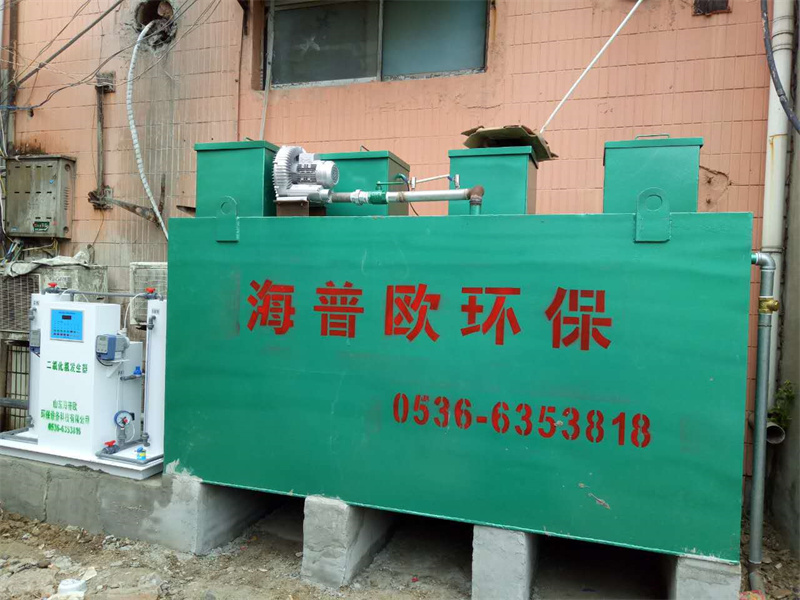
I. Core Pain Points During the New Standard Transition: Common Pitfalls of Small Medical Wastewater Treatment Equipment
The 2025 draft version of the Discharge Standard of Water Pollutants for Medical Institutions is about to be officially implemented. Grassroots medical institutions frequently encounter problems such as compliance failures and runaway costs in equipment selection and operation. Three typical issues are summarized as follows:
1. Mismatched Disinfection System Fails to Inactivate Pathogens
A community health service center adopted conventional ultraviolet disinfection equipment with a radiation dose of only 30mJ/cm². Third-party tests showed that the inactivation rate of hepatitis B virus was merely 92%, far below the new standard requirement of 99.99%. The institution had to invest an additional 120,000 RMB to reconstruct a two-stage disinfection system. This problem arises from improper selection of disinfection processes according to department types: institutions with infectious disease outpatient departments need two-stage disinfection (chlorine dioxide + ultraviolet ray), while dental clinics must install a fluoride pretreatment unit ahead of disinfection.
2. Improper Material Selection Cuts Equipment Service Life by Half
A township health hospital in northern China built disinfection tanks with carbon steel. Due to low winter temperatures and corrosive disinfectants, leakage occurred three times within three years, incurring maintenance costs exceeding 80,000 RMB. In contrast, facilities built with 316L stainless steel showed no corrosion after 10 years of operation, slashing the full-life-cycle cost by 60%. Material selection for core components must adapt to working conditions: FRP fiberglass is preferred for units contacting acidic wastewater such as laboratory sewage, and 316L stainless steel is mandatory for all disinfection sections.
3. Interrupted Data Transmission Triggers Environmental Early Warnings
A physical examination center was ordered to rectify violations because its IoT module only supported 4G network. Signal blackouts in mountainous areas caused three days of missing monitoring data. Under the new regulations, equipment must support dual-mode 4G/5G transmission with 15-day offline data storage. Twelve key indicators including inflow rate, residual chlorine and disinfection duration should be uploaded in real time to the provincial environmental supervision platform.
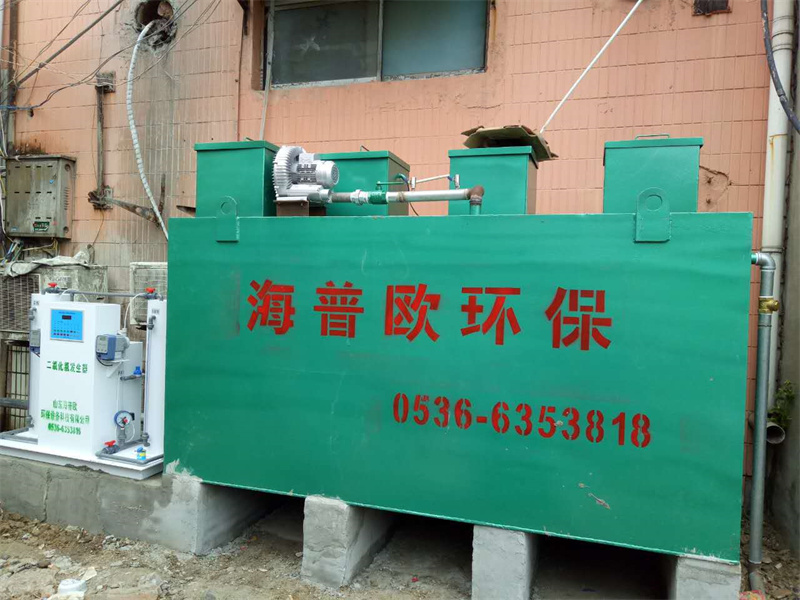
II. In-depth Analysis of Technical Routes: Optimal Equipment Selection for Different Scenarios
Selecting small medical wastewater treatment equipment relies on precise matching between technical processes and application scenarios. Three mainstream processes are available according to treatment capacity, water quality and local policies:
1. Basic Compliance Solution: Biological Contact Oxidation Process (Capacity: 50-200 tons/day)
• Core configuration: Bar screen + regulating tank + biological contact oxidation tank + sedimentation tank + chlorine dioxide disinfection
• Technical parameters: Elastic three-dimensional packing with a specific surface area of 300m²/m³; hydraulic retention time of 8-12 hours; COD removal efficiency of 80%-85%; operating cost of 1.5-2.5 RMB per ton of water
• Application scope: Township health hospitals and community outpatient clinics without special departments
• Policy adaptation: Compliant with the existing standard GB 18466-2005. The disinfection unit needs upgrading (dosage raised to 8-15mg/L) to meet the new standard.
2. Upgraded High-efficiency Solution: MBR Membrane Bioreactor Process (Capacity: 30-300 tons/day)
• Core advantages: Membrane retains activated sludge to achieve SS removal rate above 99%, reducing land occupation by 30% compared with traditional processes. Ultraviolet disinfection leaves no chemical residue, making it suitable for water reuse projects.
• Key parameters: PVDF membrane service life of 3-5 years; transmembrane pressure maintained at 0.02-0.05MPa; regular pickling with 2% citric acid can extend membrane life by 50%.
• Typical case: A community health center with dental departments adopted this process. The effluent fluoride content was controlled at 0.7mg/L with no antibiotics detected. Reclaimed water for green irrigation saved 28,000 RMB in water fees annually.
3. Special Customized Solution: Modular Combined Process (With Infectious Disease Departments / Capacity: 200-500 tons/day)
• Separate treatment design: Infectious wastewater is pretreated independently in disinfection tanks (chlorine dioxide dosage 20mg/L, retention time 2 hours) and neutralization tanks before being fed into the main treatment system.
• Process highlights: SBR sequencing batch reactor flexibly adjusts aeration cycles to handle 1.5 times peak water volume. A denitrification filter is installed for advanced treatment to achieve total phosphorus removal efficiency over 90%.
• Regional application: Medical institutions along the Yangtze River adopt this process, ensuring effluent COD ≤40mg/L and total phosphorus ≤0.3mg/L, which meets the Class Ⅳ quasi-surface water standard.
III. Operation & Maintenance Guide: Six Key Measures for Stable Equipment Operation
1. Daily Inspection: Three Mandatory Checks Every Day
• Residual chlorine: Keep the value between 0.5-2.0mg/L; replenish chlorine dioxide immediately if it drops below 0.5mg/L.
• Aeration condition: Check the uniformity of bubbles in the biological tank; clean blocked aeration discs if bubbles are uneven.
• Data transmission: Log in to the supervision platform to verify the completeness of 12 monitoring items.
2. Chemical Optimization: Dosing Skills to Cut Costs by 25%
• Chlorine dioxide generators using hydrochloric acid + sodium chlorite consume 25% less raw material than units with hydrochloric acid + sodium chlorate.
• Dynamically adjust dosage according to influent COD: increase the dosage by 1mg/L for every 10mg/L rise in COD value.
3. Emergency Troubleshooting: Quick Solutions for Three Common Faults

4. Seasonal Maintenance: Solutions for Extreme Weather
• Northern winter: Install thermal insulation layers for biochemical tanks to keep water temperature above 15℃; activate the low-temperature mode of disinfection equipment for stable operation under -10℃.
• Southern rainy season: Install emergency lift pumps in regulating tanks to prevent overflow and short-circuit flow caused by excessive water volume.
IV. Policy Benefits & Compliance: Three Critical Regulations for 2025
1. Subsidy application: Many regions offer 30%-50% procurement subsidies for new-standard compliant equipment. Applicants need to submit third-party test reports and data uploading records; the annual application window usually closes in March and April.
2. Regional differences: The Yellow River Basin enforces a total nitrogen limit of ≤15mg/L, requiring anoxic denitrification sections with 2-3mg/L carbon source dosing. The Pearl River Delta additionally requires monitoring of total copper and total zinc.
3. Acceptance criteria: After the new standard takes effect, project acceptance includes two new tests: viral inactivation testing conducted by CMA-certified institutions and 15-day offline data storage testing.
V. Conclusion
Driven by stricter environmental policies and technological upgrading, small medical wastewater treatment equipment is evolving toward precision, intelligence and low carbon. Instead of focusing merely on low prices, medical institutions should evaluate equipment from three dimensions: process adaptability, material durability and data compliance. Precise chemical dosing, intelligent monitoring and regular maintenance help reduce operating costs while keeping stable effluent quality. In the future, intelligent equipment compatible with new emission standards, equipped with remote operation and energy-saving modules will dominate the market, providing reliable environmental compliance solutions for grassroots medical facilities.
Related Products
Related News
- 牡丹江市New Trends in the Development of the MBR Membrane Wastewater Treatment Industry: A Professional Guide to Selecting Source Manufacturers
- 牡丹江市How to Select Wastewater Treatment Equipment for Pig Farms? In-depth Review of Trusted Industry Service Providers
- 牡丹江市Hard-to-Treat Slaughterhouse Wastewater? Tested & Recommended High-Adaptability Wastewater Treatment Solutions for 2026
- 牡丹江市How to Select Integrated Wastewater Treatment Equipment? In-depth Review of Trustworthy Source Manufacturers Recognized by Industry Insiders
- 牡丹江市How to Select Buried Integrated Wastewater Treatment Equipment? Strength Evaluation of Reliable Brands in 2026
- 牡丹江市Inventory of New Coal Mine Water Treatment Technologies! How to Select Cost-Effective Manufacturers & Avoid Common Pitfalls
- 牡丹江市Textile Printing & Dyeing Wastewater Treatment Is Tough? These Four Powerful Enterprises Easily Solve Core Industry Pain Points
- 牡丹江市Authoritative Evaluation of High-Salinity Wastewater Treatment Equipment | Top Recommended Brands of 2026
- 牡丹江市Which Supplier Offers Reliable Integrated Sewage Treatment Equipment? Multi-dimensional Actual Test Comparison & Top Recommended Brands Released
- 牡丹江市Electroplating Factory Wastewater Treatment Engineering Cases
About Us
products
Business
News
Contact Us
Service Hotline:+86-15253659088WhatsApp: +86 18706508001
Email: jly@haipuou.group
Address: No.56, Donghuan Road, Zhucheng City, Weifang City, Shandong Province, China