


- Home
- About Us
About Us
- Product
Product
- Cases
Cases
- R&D Technology
- News
News
- Contact Us


- Default Language
 EN
EN RU
RU ES
ES DE
DE EL
EL IT
IT JA
JA KO
KO PT
PT ID
ID SR
SR UK
UK VI
VI TH
TH TR
TR MS
MS BE
BE AR
AR
Buried sewage treatment equipment is an innovative solution to solve urban and rural sewage problems.
Date:July 13, 2025ID: 2199Views: 1213
Haipuou Environmental Protection Group Co., Ltd. specializes in the construction of sewage treatment projects and the production and sales of water treatment equipment. Its main products include integrated sewage treatment equipment, high-efficiency cyclone purifiers, magnetic separation sewage treatment equipment, prefabricated sewage treatment plants, smart water management platforms, sludge thickening equipment, air flotation machines and so on.
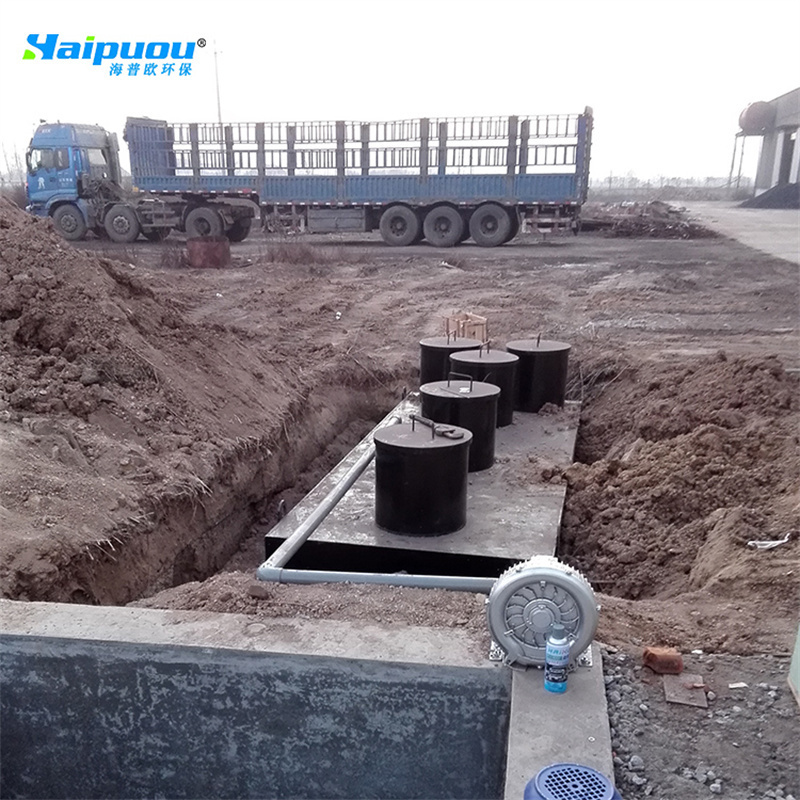
Against the dual backdrop of accelerated urbanization and rural revitalization strategy, sewage treatment has become a key part of ecological environment protection. Restricted by large investment, extensive land occupation and complicated pipe network construction, traditional sewage treatment plants can hardly meet the demands of comprehensive urban-rural sewage treatment. As a new type of sewage treatment technology, buried sewage treatment equipment boasts unique advantages. It has gradually become an innovative solution to urban and rural sewage problems and injected new vitality into the wastewater treatment industry.
I. Core Advantages of Buried Sewage Treatment Equipment
Small Land Footprint for Diverse Application Scenarios
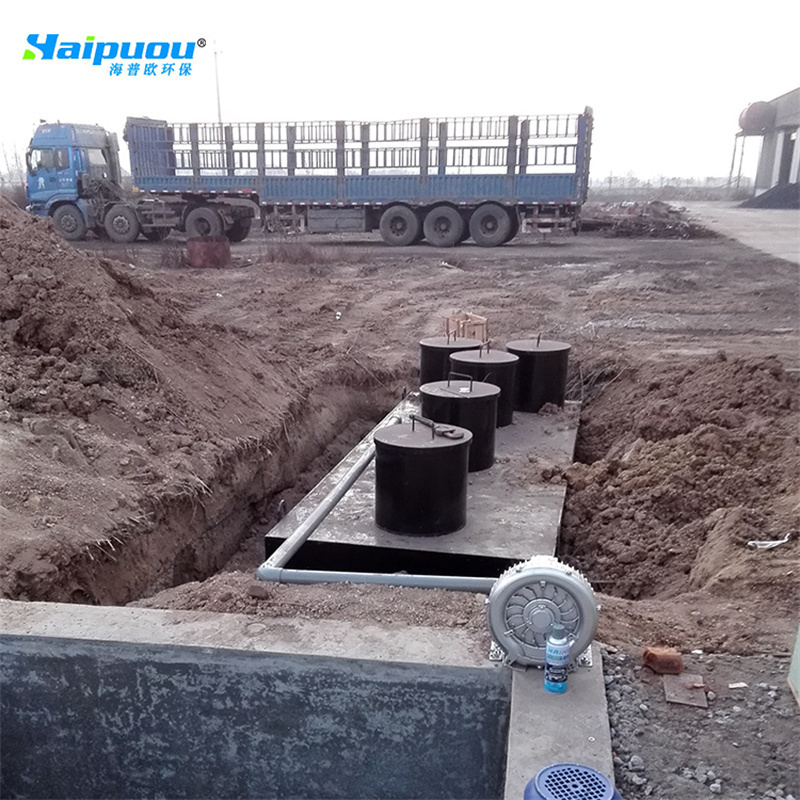
Buried sewage treatment equipment is installed underground. The main structure is buried below the ground, and the ground surface can be reused for greening or hardening, which greatly reduces land occupation. This design makes it suitable for land-scarce areas such as suburban districts and industrial parks, as well as scattered rural sewage treatment projects including villages and rural settlements. It avoids large occupation of cultivated land and construction land, and effectively solves the difficulties of site selection and excessive land use of traditional sewage treatment plants.
Low Investment Cost and Short Construction Period
Compared with conventional sewage treatment plants, buried equipment features lower investment. On one hand, it cuts the cost of massive civil engineering work, only requiring simple foundation excavation and equipment installation. On the other hand, the modular structure allows flexible combination according to treatment capacity, preventing resource waste caused by over-construction. Besides, the whole construction cycle is relatively short. The whole process from production to installation and commissioning usually only takes several weeks, so the equipment can be quickly put into operation to meet urgent sewage treatment demands.
Low Energy Consumption with Remarkable Environmental Benefits
The equipment adopts high-efficiency biological treatment technologies such as A/O process and MBR process to purify sewage through microbial metabolism. It consumes far less electric power than traditional treatment plants. Some units can even run with auxiliary renewable energy including solar energy and wind energy to further lower operating costs. In addition, only a small volume of sludge is generated during treatment. The treated sludge can be recycled for resource utilization, easing the environmental pressure from sludge disposal and bringing prominent eco-friendly benefits.
Powerful Adaptability and Stable Treatment Effect
The equipment can cope with fluctuations in water quality and volume. It can efficiently treat domestic sewage, industrial wastewater and scattered rural sewage by adjusting process parameters. Equipped with an advanced control system, it monitors real-time indicators such as COD, ammonia nitrogen and total phosphorus, and automatically adjusts operating conditions to guarantee stable effluent quality up to standards. The equipment can keep running normally under harsh weather such as high temperature, low temperature and rainstorms without being affected by external conditions.
II. Application Scenarios of Buried Sewage Treatment Equipment
Urban Sewage Treatment
In urban sewage treatment, buried equipment can act as a supplement or alternative to municipal sewage treatment plants. For new urban districts and suburbs without covered pipe networks, buried sewage stations can realize on-site treatment and water reuse and reduce pollution from sewage discharge. Moreover, the equipment can be used for upgrading existing sewage plants to improve treatment capacity and effluent quality.
Rural Sewage Treatment
Rural sewage is characterized by scattered sources, small flow and volatile water quality, which cannot be handled by conventional centralized treatment modes. Buried equipment supports decentralized treatment. Treatment stations can be flexibly arranged according to village distribution and sewage volume to collect, treat and discharge sewage locally. For remote mountainous areas, small buried units can treat domestic sewage from single households or multiple families and curb random sewage discharge in rural regions.
Sewage Treatment for Industrial Parks
Industrial park sewage features complex composition and high pollutant concentration, which puts forward high requirements for treatment equipment. Custom treatment processes including pretreatment, biological treatment and advanced treatment can be designed according to wastewater characteristics of different parks to effectively remove organic matter, heavy metals and other pollutants and ensure effluent meets national discharge standards. Meanwhile, the underground installation saves above-ground space for industrial enterprises.
Sewage Treatment for Tourist Scenic Spots
Wastewater in scenic areas mainly comes from tourists' domestic sewage and catering wastewater, with prominent seasonality and large flow fluctuation. Buried equipment can adjust treatment capacity flexibly in peak and off tourist seasons to meet treatment demands during travel rush hours. Besides, the concealed installation can be well integrated with natural landscapes without spoiling the scenic beauty.
III. Technical Principle of Buried Sewage Treatment Equipment
The core technology of buried sewage treatment equipment is biological treatment. Its basic principle is to decompose organic pollutants into harmless substances such as carbon dioxide and water through microbial metabolism. Specifically, the equipment mainly consists of the following treatment units:
Pretreatment Unit
The pretreatment unit is designed to remove large solid impurities, suspended solids and oil contaminants to guarantee stable operation of subsequent processes. It generally includes bar screens, grit chambers and oil separators to separate pollutants via physical and chemical methods.
Biological Treatment Unit
The biological treatment unit is the core component, responsible for removing organic matter, ammonia nitrogen, total phosphorus and other pollutants. It can be divided into aerobic, anaerobic and anoxic treatment units based on different biological technologies. The A/O (anaerobic-aerobic) process is widely adopted. The combination of anaerobic and aerobic tanks realizes organic matter degradation as well as nitrogen and phosphorus removal.
Advanced Treatment Unit
The advanced treatment unit further removes residual pollutants to upgrade water quality for reuse or standard discharge. It is equipped with filtration and disinfection devices. Filtration removes suspended solids and colloids, while disinfection kills bacteria, viruses and other microorganisms.
Sludge Treatment Unit
The sludge treatment unit disposes excess sludge generated in biological treatment, reduces sludge volume and moisture content for convenient transportation and disposal. It includes sludge thickening and dewatering equipment. After treatment, sludge can be landfilled, incinerated or recycled as resources.
IV. Development Trend of Buried Sewage Treatment Equipment
Continuous Improvement of Intelligence
Driven by IoT, big data and artificial intelligence, the intelligent level of buried sewage treatment equipment will keep improving. Future units will be fitted with advanced monitoring and control systems to track all water quality indicators in real time and automatically adjust operating parameters for intelligent management. Remote monitoring and fault diagnosis will also be available, so users can check equipment status anytime on mobile phones or computers and troubleshoot problems timely.
Deeper Resource Recycling
With increasingly strict environmental regulations, resource recovery will be further promoted. New-generation equipment will not only purify sewage, but also recycle water resources, energy and nutrients to build circular resource systems. For instance, membrane separation technology reclaims water for irrigation and vehicle washing; anaerobic digestion recovers biogas energy; phosphorus recovery technology extracts phosphorus for fertilizer production.
Constant Innovation in Process Technology
To satisfy stricter environmental standards and diversified client demands, process technologies will keep being upgraded. High-efficiency, energy-saving and eco-friendly technologies such as MBR and MBBR will be widely applied to raise treatment efficiency and effluent quality. The equipment will also be combined with advanced oxidation and constructed wetland technologies to form a complete wastewater treatment system.
Expanding Application Scope
As the technology matures and production cost declines, the application range will keep expanding. Apart from traditional urban, rural and industrial park projects, the equipment will be deployed on ships, airports and high-speed railway stations to provide sewage treatment solutions for more scenarios.
In conclusion, as an innovative wastewater treatment technology, buried sewage treatment equipment has prominent merits including small land occupation, low investment, low energy consumption and strong adaptability, boasting broad prospects in urban-rural sewage governance. With continuous technological innovation, it will achieve higher intelligence, deeper resource recovery, upgraded processes and wider application, making greater contributions to the sustainable development of the wastewater treatment industry.
Related Products
Related News
- New Trends in the Development of the MBR Membrane Wastewater Treatment Industry: A Professional Guide to Selecting Source Manufacturers
- How to Select Wastewater Treatment Equipment for Pig Farms? In-depth Review of Trusted Industry Service Providers
- Hard-to-Treat Slaughterhouse Wastewater? Tested & Recommended High-Adaptability Wastewater Treatment Solutions for 2026
- How to Select Integrated Wastewater Treatment Equipment? In-depth Review of Trustworthy Source Manufacturers Recognized by Industry Insiders
- How to Select Buried Integrated Wastewater Treatment Equipment? Strength Evaluation of Reliable Brands in 2026
- Inventory of New Coal Mine Water Treatment Technologies! How to Select Cost-Effective Manufacturers & Avoid Common Pitfalls
- Textile Printing & Dyeing Wastewater Treatment Is Tough? These Four Powerful Enterprises Easily Solve Core Industry Pain Points
- Authoritative Evaluation of High-Salinity Wastewater Treatment Equipment | Top Recommended Brands of 2026
- Which Supplier Offers Reliable Integrated Sewage Treatment Equipment? Multi-dimensional Actual Test Comparison & Top Recommended Brands Released
- Electroplating Factory Wastewater Treatment Engineering Cases
About Us
products
Business
News
Contact Us
Service Hotline:+86-15253659088WhatsApp: +86 18706508001
Email: jly@haipuou.group
Address: No.56, Donghuan Road, Zhucheng City, Weifang City, Shandong Province, China