

- Home
- About Us
About Us
- Product
Product
- Cases
Cases
- R&D Technology
- News
News
- Contact Us


- Default Language
 EN
EN RU
RU ES
ES DE
DE EL
EL IT
IT JA
JA KO
KO PT
PT ID
ID SR
SR UK
UK VI
VI TH
TH TR
TR MS
MS BE
BE AR
AR
Comprehensive Analysis of Sewage Sludge Treatment Technologies: Process Selection, Resource Recovery & Industry Development Trends
Introduction
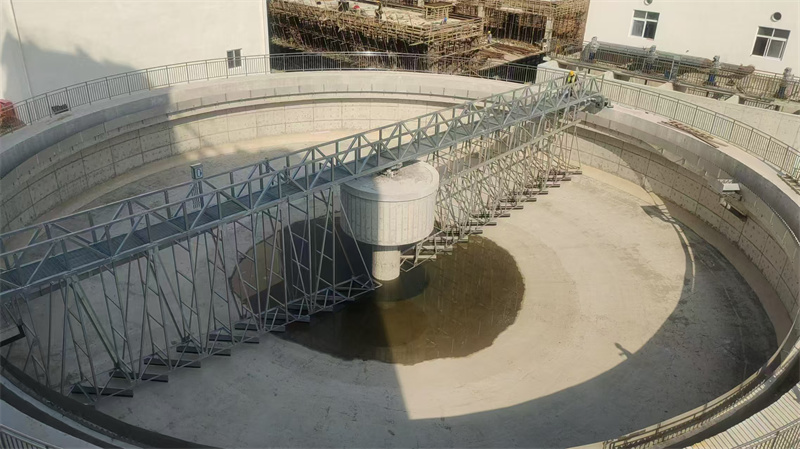
With accelerated urbanization and industrial expansion, China’s total sewage treatment volume keeps rising, making sludge treatment a critical link in water environment governance. Sludge is rich in organic matter, nitrogen, phosphorus and heavy metals; improper disposal will easily trigger secondary pollution. Scientific sludge treatment realizes volume reduction, harmless treatment and resource recovery, complying with the Dual Carbon Goals and national solid waste recycling policies. This paper elaborates on industry status quo, core technologies, process selection, resource recovery routes and future trends to provide professional references for practitioners in the sector.
I. Current Status & Environmental Demand of the Sludge Treatment Industry
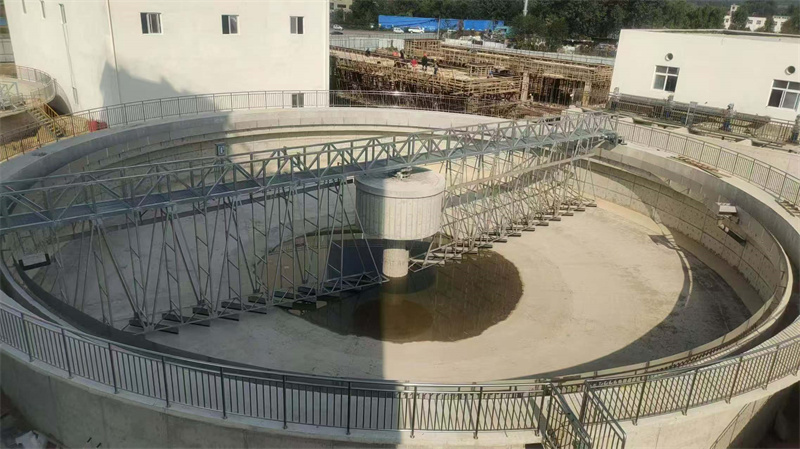
China’s annual dry sludge output exceeds 60 million tons and maintains steady growth. In the early stage, sludge was mainly disposed of by simple landfilling, which brought drawbacks such as massive land occupation and leachate pollution risks.
Driven by policies including the 14th Five-Year Plan for Urban Sewage Treatment and Resource Utilization and the Law of the People's Republic of China on the Prevention and Control of Environmental Pollution by Solid Waste, the industry target has shifted from mere harmless treatment to coordinated development of volume reduction, stabilization, resource recovery and low-carbon transformation. Landfilling capacity is gradually cut down, while co-disposal and resource recycling have become mainstream solutions.
II. Core Technologies & Process Flow of Sludge Treatment
Sludge treatment follows the route of "pre-treatment – core stabilization – resource end disposal", with full-range mainstream technologies catering to diverse project demands.
1. Pre-treatment: Thickening & Dewatering
Gravity thickening: reduces sludge volume and cuts the load of subsequent processes, widely adopted as front-end treatment in large sewage plants.
Mechanical dewatering: equipment including plate-and-frame filter presses, centrifugal dehydrators and high-pressure membrane filter presses lowers sludge moisture content from 98% to below 80%. High-pressure membrane filtration can achieve moisture content ≤50%, drastically slashing transportation and disposal costs.
2. Stabilization Treatment
Anaerobic digestion: microorganisms break down organics to produce methane in airtight anaerobic environments, recovering clean energy while stabilizing sludge with a volume reduction rate of 30%–40%. It serves as a dominant low-carbon process for medium and large sewage plants.
Aerobic composting: high-temperature aerobic fermentation eliminates pathogenic bacteria, and the final product can be used as soil conditioner, suitable for municipal sludge with high organic content and low heavy metal concentration.
3. Advanced Volume Reduction Technologies
Thermal drying: heat energy reduces sludge moisture content to 10%–30% with volume reduction over 70%, laying foundation for incineration and co-disposal.
Incineration disposal: organics are fully oxidized at temperatures above 850°C with a volume reduction rate exceeding 90%, completely eliminating hazardous substances. Sludge can be co-disposed with municipal solid waste incinerators, thermal power plants and cement kilns to lower capital and operation costs.
Pyrolysis & gasification: sludge is converted into combustible gas and biochar under medium-high temperature oxygen-deficient conditions, featuring high energy recovery efficiency and controllable secondary pollution as an emerging low-carbon technical route.
4. Harmless & Resource-oriented End Disposal
Building material recycling: sludge is made into bricks, ceramsite, cement admixtures and road base materials, realizing large-scale solid waste absorption in line with the urban mineral policy.
Land application: qualified sludge is used for landscape greening and soil remediation to recycle organic matter and nutrients.
Energy recovery: biogas generated from anaerobic digestion and pyrolysis gas can be used for power generation, supporting carbon neutrality of sewage treatment plants.
III. Process Comparison & Key Selection Principles for Sludge Treatment
Various processes differ greatly in capital investment, operating cost and applicable scenarios. Process selection shall comprehensively consider sludge characteristics, site conditions and environmental protection requirements.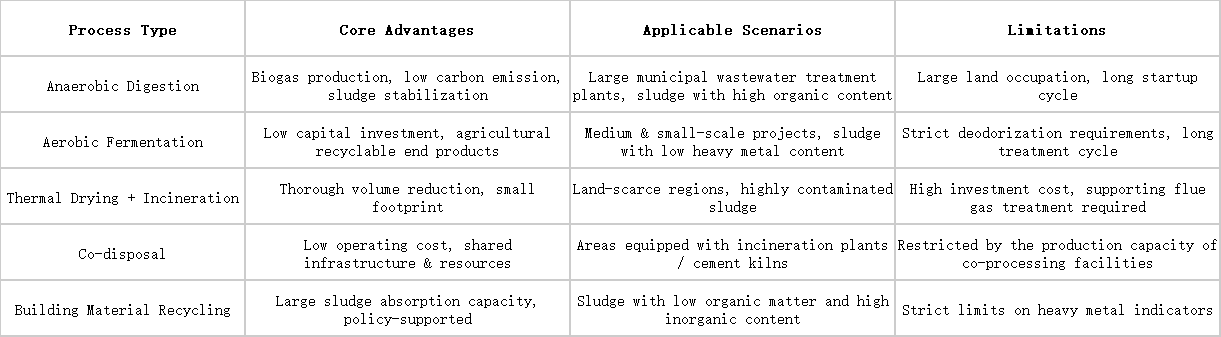
Core selection principles: prioritize resource recovery, strictly control secondary pollution, match regional treatment capacity, and balance low-carbon performance and economic efficiency.
IV. Innovative Routes for Sludge Resource Utilization
Resource recycling is the core development direction of the sludge industry, combining mature techniques and emerging innovations:
Phosphorus recovery: struvite crystallization recovers phosphorus with a recovery rate up to 85%, alleviating the shortage of phosphate mineral resources.
Biomass fuel production: dried sludge acts as alternative fuel for industrial heating and power generation; China has taken the lead in formulating relevant international standards.
Biochar preparation: pyrolysis biochar is applied in soil remediation and heavy metal adsorption to realize high value-added utilization.
Integrated co-disposal: combined drying, incineration and building material recycling forms a closed-loop treatment system to boost comprehensive benefits.
V. Industrial Policies & Future Development Trends
Policy Guidance
The state clearly promotes coordinated pollution reduction and carbon mitigation in sludge treatment, encourages the "biomass utilization + incineration" model, standardizes emission control of co-disposal projects, increases subsidies for resource recycling, and pushes synchronous construction of sludge facilities and sewage treatment plants.
Development Trends
Low-carbon transformation: low-energy drying, waste heat recovery and anaerobic digestion upgrading become key technical upgrading focuses.
Intelligent operation: online monitoring, intelligent regulation and digital operation & maintenance improve treatment efficiency and operational stability.
Closed-loop circulation: full-chain circulation of "sewage – sludge – resource/energy" realizes near-zero discharge of solid waste.
Standardization: industrial specifications align with international standards to drive domestic technical equipment localization and export.
Conclusion
Sludge treatment is the final link of water environment governance, as well as an important carrier for solid waste recycling and carbon neutrality. Transforming from simple landfilling to diversified resource recovery, the whole industry is stepping into a new stage of high-efficiency, low-carbon and circular development. Enterprises and project owners shall select matched processes based on actual conditions, balance environmental compliance and economic benefits, and fuel high-quality development of the sludge treatment sector.
Related Products
Related News
- New Trends in the Development of the MBR Membrane Wastewater Treatment Industry: A Professional Guide to Selecting Source Manufacturers
- How to Select Wastewater Treatment Equipment for Pig Farms? In-depth Review of Trusted Industry Service Providers
- Hard-to-Treat Slaughterhouse Wastewater? Tested & Recommended High-Adaptability Wastewater Treatment Solutions for 2026
- How to Select Integrated Wastewater Treatment Equipment? In-depth Review of Trustworthy Source Manufacturers Recognized by Industry Insiders
- How to Select Buried Integrated Wastewater Treatment Equipment? Strength Evaluation of Reliable Brands in 2026
- Inventory of New Coal Mine Water Treatment Technologies! How to Select Cost-Effective Manufacturers & Avoid Common Pitfalls
- Textile Printing & Dyeing Wastewater Treatment Is Tough? These Four Powerful Enterprises Easily Solve Core Industry Pain Points
- Authoritative Evaluation of High-Salinity Wastewater Treatment Equipment | Top Recommended Brands of 2026
- Which Supplier Offers Reliable Integrated Sewage Treatment Equipment? Multi-dimensional Actual Test Comparison & Top Recommended Brands Released
- Electroplating Factory Wastewater Treatment Engineering Cases
About Us
products
Business
News
Contact Us
Service Hotline:+86-15253659088WhatsApp: +86 18706508001
Email: jly@haipuou.group
Address: No.56, Donghuan Road, Zhucheng City, Weifang City, Shandong Province, China