


- Home
- About Us
About Us
- Product
Product
- Cases
Cases
- R&D Technology
- News
News
- Contact Us


- Default Language
 EN
EN RU
RU ES
ES DE
DE EL
EL IT
IT JA
JA KO
KO PT
PT ID
ID SR
SR UK
UK VI
VI TH
TH TR
TR MS
MS BE
BE AR
AR
荆州市Full-dimensional Analysis of Wastewater Treatment Equipment Prices: Explore Root Causes of Quotation Differences & Master Accurate Procurement Strategies
Date:July 13, 2025ID: 2243Views: 1075
Haipuou Environmental Protection Group Co., Ltd. specializes in the construction of wastewater treatment projects and the production and sales of water treatment equipment. Its main products include integrated wastewater treatment equipment, high-efficiency cyclone purifiers, magnetic separation wastewater treatment equipment, prefabricated wastewater treatment plants, smart water management platforms, sludge thickening equipment, air flotation machines and so on.
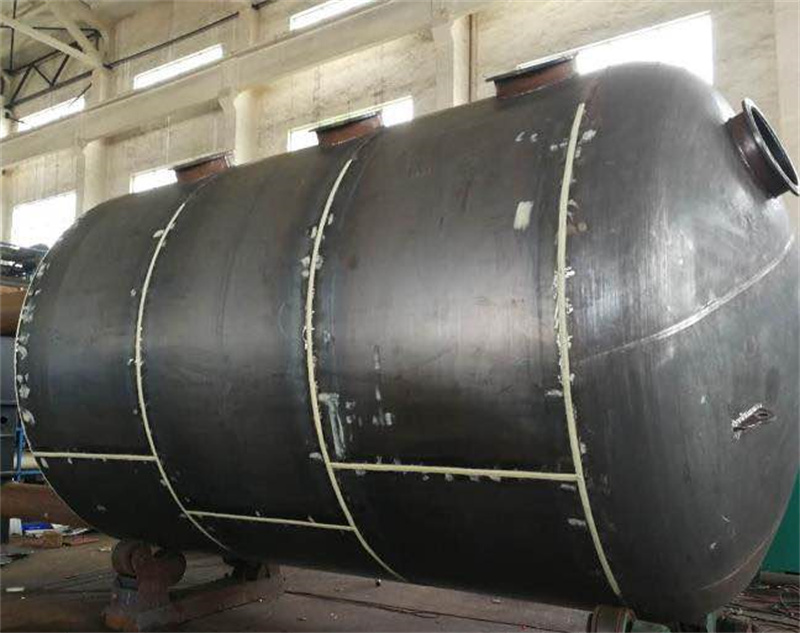
Driven by stricter environmental policies and growing water scarcity, wastewater treatment equipment has become essential infrastructure for industrial production, municipal construction and rural renovation projects. Faced with a wide range of equipment on the market, buyers always focus closely on price lists for wastewater treatment equipment. Combined with the latest industry data of 2024, this article elaborates on cost composition, categorized price references and equipment selection tips, offering solid support for procurement decisions.
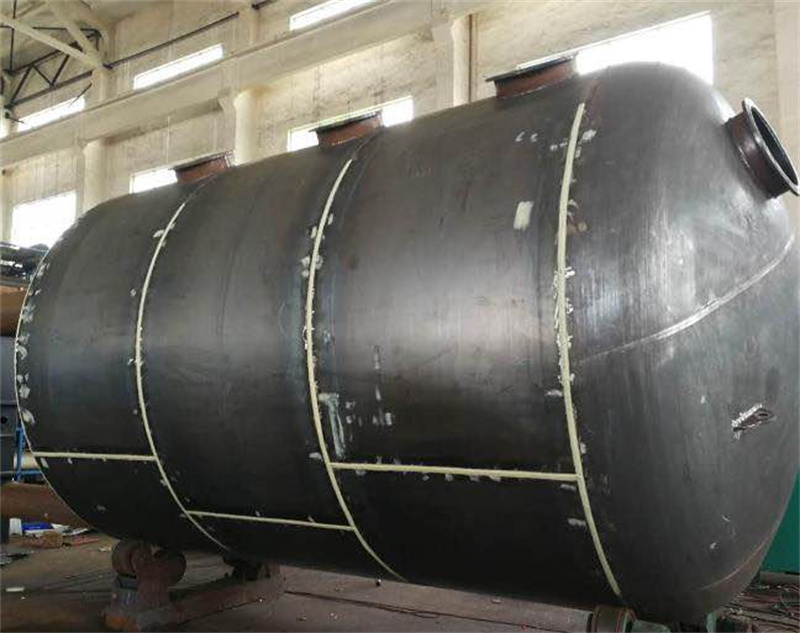
I. Key Factors Affecting the Price of Wastewater Treatment Equipment
The price of wastewater treatment equipment is not fixed but determined by multiple variables. Buyers should clarify their actual demands to match the budget accurately before purchase.
Treatment Capacity and Water Quality Standards: Equipment with a capacity ranging from 5m³/h to 1000m³/h can differ in price by dozens of times. Small domestic sewage treatment equipment (5-20m³/h) adopts simple processes with relatively low costs, while facilities for high-concentration industrial organic wastewater (over 100m³/h) require advanced oxidation, membrane separation and other complex technologies, which push up the price greatly. In addition, effluent requirements such as Grade A standard of GB18918-2002 or industrial water reuse standards will also change equipment configuration and overall cost.
Core Processes and Materials: Common technologies include MBR membrane bioreactor, A/O process, SBR sequencing batch reactor and integrated wastewater treatment equipment. The MBR process delivers better effluent quality with smaller land occupation, costing 30%-50% more than the traditional A/O process. In terms of materials, anti-corrosion carbon steel is low-cost, while 304/316 stainless steel with strong corrosion resistance is 20%-40% higher in price. Fiberglass reinforced plastic (FRP) is more cost-effective under special working conditions.
Auxiliary Equipment & Automation Level: A complete wastewater treatment system includes bar screens, sedimentation tanks, aerators, chemical dosing systems, disinfection devices, sludge dewaterers and other accessories. More supporting units lead to higher total costs. Automatic control systems such as PLC remote monitoring and online water quality monitoring improve operation efficiency, accounting for 5%-15% of the total project cost.
Manufacturer Qualification and After-sales Service: Regular manufacturers with R&D credentials and EIA certification guarantee stable product quality, with prices 10%-20% higher than small workshops. On-site installation, commissioning training and long-term maintenance services are also included in quotations. A complete service system can effectively reduce operational risks in later stages.
II. Reference Price List of Wastewater Treatment Equipment (2024)
The following figures are average market quotations for reference only. Exact costs shall be calculated according to actual project requirements.
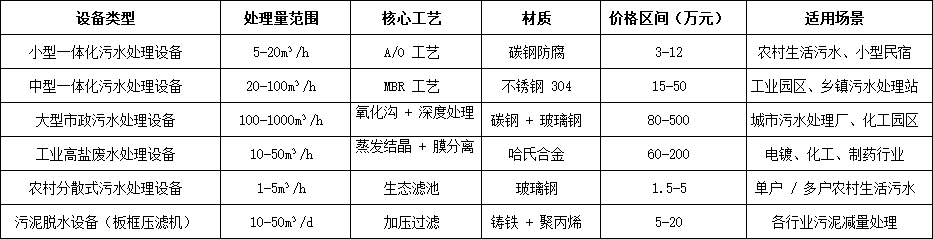
Note: The above prices cover main equipment, standard accessories, installation and commissioning, excluding civil construction and freight charges. Quotations will fluctuate with raw material prices and technical upgrades. Please confirm the latest price with manufacturers before ordering.
III. Practical Tips for Procurement & Equipment Selection
Clarify demands to avoid overconfiguration: Confirm treatment capacity and technical routes based on sewage discharge volume and water quality indicators (COD, BOD, ammonia nitrogen, total phosphorus, etc.). Domestic sewage treatment does not require high-cost industrial-grade equipment to avoid unnecessary capital waste.
Verify manufacturer qualifications and guard against low-price traps: Prioritize suppliers with Professional Contracting Qualification for Environmental Projects and ISO quality certification, and ask for test reports and finished project cases. Ultra-low-price products often suffer from substandard materials and simplified processes, resulting in frequent breakdowns during operation.
Evaluate long-term O&M cost to measure overall cost performance: The procurement cost is only the upfront investment. Later expenses including power consumption, chemical dosage and maintenance must be taken into full consideration. Although MBR equipment requires higher initial investment, its operating cost is 15%-20% lower than traditional processes, bringing better economic benefits in long-term operation.
Apply for policy subsidies: Many local governments offer subsidies for environmental equipment procurement (ranging from 30% to 50% for rural sewage facilities). Consult local environmental authorities in advance to cut procurement expenditure.
IV. Conclusion
The price of wastewater treatment equipment is affected by capacity, technical processes, materials and many other factors. Buyers should not simply chase the lowest price. Instead, choose products that match project demands with reliable quality and comprehensive after-sales service. If you need an accurate price list, please provide water quality test reports and treatment capacity requirements. We will customize exclusive treatment schemes and quotations to help you achieve compliant wastewater discharge at the lowest total cost.
Related Products
Related News
- 荆州市New Trends in the Development of the MBR Membrane Wastewater Treatment Industry: A Professional Guide to Selecting Source Manufacturers
- 荆州市How to Select Wastewater Treatment Equipment for Pig Farms? In-depth Review of Trusted Industry Service Providers
- 荆州市Hard-to-Treat Slaughterhouse Wastewater? Tested & Recommended High-Adaptability Wastewater Treatment Solutions for 2026
- 荆州市How to Select Integrated Wastewater Treatment Equipment? In-depth Review of Trustworthy Source Manufacturers Recognized by Industry Insiders
- 荆州市How to Select Buried Integrated Wastewater Treatment Equipment? Strength Evaluation of Reliable Brands in 2026
- 荆州市Inventory of New Coal Mine Water Treatment Technologies! How to Select Cost-Effective Manufacturers & Avoid Common Pitfalls
- 荆州市Textile Printing & Dyeing Wastewater Treatment Is Tough? These Four Powerful Enterprises Easily Solve Core Industry Pain Points
- 荆州市Authoritative Evaluation of High-Salinity Wastewater Treatment Equipment | Top Recommended Brands of 2026
- 荆州市Which Supplier Offers Reliable Integrated Sewage Treatment Equipment? Multi-dimensional Actual Test Comparison & Top Recommended Brands Released
- 荆州市Electroplating Factory Wastewater Treatment Engineering Cases
About Us
products
Business
News
Contact Us
Service Hotline:+86-15253659088WhatsApp: +86 18706508001
Email: jly@haipuou.group
Address: No.56, Donghuan Road, Zhucheng City, Weifang City, Shandong Province, China