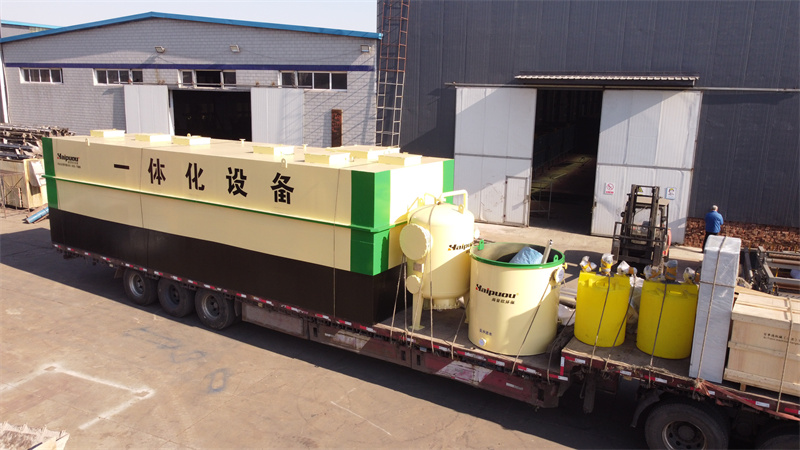
With continuously tightening environmental policies, integrated domestic sewage treatment equipment has become essential infrastructure for villages, scenic spots, residential communities and other scenarios. Selecting a reliable manufacturer is critical to achieving stable effluent compliance and cutting operation and maintenance costs. Market research shows that more than 35% of sewage treatment projects suffer from equipment breakdowns and substandard discharge due to poor vendor selection. This article elaborates on how to screen high-quality manufacturers of integrated domestic sewage treatment equipment from core dimensions including technology, qualifications and after-sales service.
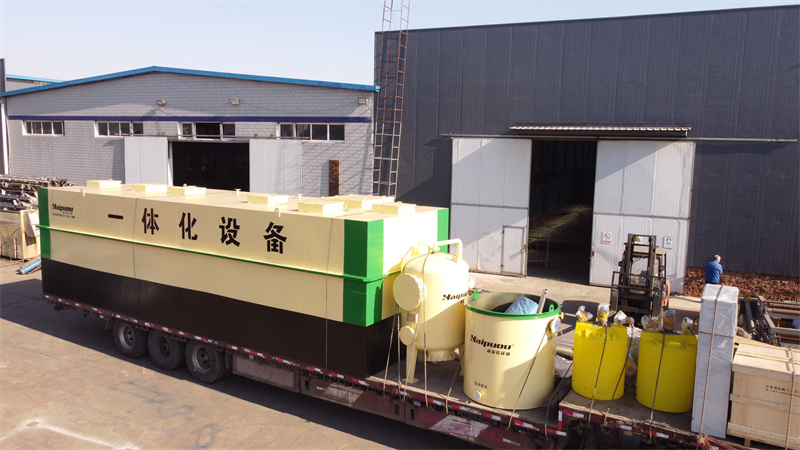
I. Verify Technical Strength: Qualified Craftsmanship and Manufacturing Standards
The core competitiveness of reputable manufacturers lies in a mature technical system. First of all, pay attention to process adaptability. Reliable suppliers deliver customized solutions according to domestic sewage quality indicators such as COD and ammonia nitrogen concentrations, instead of applying a universal process package to all projects. Proven mainstream processes include AO, A²O and MBR. You may request third-party test reports and field operation data from manufacturers. Next, inspect their manufacturing capacity. Visit production workshops to check anti-corrosion treatment (double-layer protection with epoxy asphalt and FRP is the industry standard), welding quality and plate thickness. Also verify the stability of PLC control systems (brands such as Siemens and Schneider are preferred) and remote monitoring platforms.
Adoption of innovative technologies serves as an extra advantage. Manufacturers combining biological contact oxidation with high-specific-area elastic packing produce equipment with stronger anti-shock load capacity. Units equipped with intelligent aeration and variable frequency control can reduce energy consumption by 30% compared with traditional equipment. In addition, adaptability to extreme environments deserves close attention. For northern regions, manufacturers must provide thermal insulation design to guarantee stable operation even at -30℃.
II. Check Qualifications and Project Cases: Compliance and Practical Experience as Dual Guarantees
Official certifications form the basic threshold for legitimate operation. Qualified manufacturers of integrated domestic sewage treatment equipment shall hold ISO three-system certifications (ISO 9001/14001/45001), professional contracting qualifications for environmental engineering, CCC certification for electrical components, and China Environmental Labeling Certification (Ten-Ring Certification). These credentials are not only policy requirements, but also direct proof of product quality and environmental performance.
Completed projects are the most intuitive evidence of strength. Ask suppliers to provide a list of similar projects finished in the past three years, with clear data on treatment capacity, influent and effluent standards, and service life. It is recommended to inspect at least two projects that have run steadily for more than one year. Prioritize cases matching your project type: buried equipment with a capacity of 50-500m³/d for rural sewage treatment, and quickly deployable containerized units for scenic area projects. Manufacturers that have drafted industry standards or own exclusive patents enjoy higher technical credibility.
III. Calculate Full Life-cycle Costs: Steer Clear of Low-price Traps
Do not judge procurement merely by the initial quotation; full life-cycle cost reflects the true value of the equipment. Trustworthy manufacturers offer itemized quotations, breaking down equipment cost, installation guidance fees, commissioning charges and one-year operation expenses to prevent hidden extra costs later. Be wary of abnormally low bids. Such products are usually made with inferior materials and reduced spare parts, and the cost of subsequent repairs and renovation may reach 3 to 5 times the original equipment price.
Calculating long-term operating costs is vital. Ask manufacturers to provide data including daily power consumption, sludge yield and chemical dosage under different working conditions, then calculate overall expenditure based on local water and electricity prices. Vendors with low-carbon energy-saving designs are more preferable. For example, equipment that recovers biogas from anaerobic tanks to cut power use, or supports water reuse can greatly lower long-term expenses; some projects save hundreds of thousands of RMB on water bills annually.
IV. Evaluate Service Capacity: End-to-end Comprehensive Support
After-sales service runs through the entire lifespan of integrated domestic sewage treatment equipment, covering pre-sales consultation and long-term maintenance. High-quality manufacturers provide free water quality testing, scheme design, lab-scale and pilot tests to ensure perfect matching between equipment and actual sewage conditions. During installation and commissioning, confirm whether professional technical guidance is available; modular equipment should be installed and put into trial operation within 48 hours.
Localized after-sales response is a key evaluation factor. It is better to select manufacturers with local service stations. The industry benchmark is a 2-hour initial response and on-site troubleshooting within 24 hours. Also examine their maintenance system: operator training, simulation software, AR remote guidance, sufficient spare parts inventory and emergency plans. Suppliers offering a main equipment warranty of no less than 5 years effectively reduce long-term operational risks.
V. Avoid Legal Risks: Clarify All Contract Clauses
Detailed contract terms serve as the last safeguard for your legitimate rights. The contract must specify guaranteed performance indicators, such as COD removal rate ≥85% and ammonia nitrogen removal rate ≥70%. Clarify the warranty period, fault repair response time and liability for breach, including daily liquidated damages if effluent fails to meet standards. You may also require a bank performance bond of no less than 10% of the total contract value to mitigate performance risks.
Besides, confirm the ownership of process patents to avoid project shutdown caused by intellectual property infringement. Define acceptance criteria and procedures, and require manufacturers to submit complete process calculation documents and test reports to ensure effluent meets Grade A standard of GB 18918 or corresponding industrial specifications.
The core principle of selecting manufacturers for integrated domestic sewage treatment equipment is to strike a balance between technical adaptation, regulatory compliance, cost control and after-sales guarantee. Amid stricter environmental supervision, outstanding vendors are more than just equipment suppliers; they are long-term partners guaranteeing continuous stable operation of projects. Rigorous multi-dimensional assessment will help you find the most suitable manufacturer and lay a solid foundation for your sewage treatment project.




 EN
EN RU
RU ES
ES DE
DE EL
EL IT
IT JA
JA KO
KO PT
PT ID
ID SR
SR UK
UK VI
VI TH
TH TR
TR MS
MS BE
BE AR
AR