


- Home
- About Us
About Us
- Product
Product
- Cases
Cases
- R&D Technology
- News
News
- Contact Us


- Default Language
 EN
EN RU
RU ES
ES DE
DE EL
EL IT
IT JA
JA KO
KO PT
PT ID
ID SR
SR UK
UK VI
VI TH
TH TR
TR MS
MS BE
BE AR
AR
辽阳市Influencing Factors, Price Range Reference and Purchase Guide for Domestic Sewage Treatment Equipment
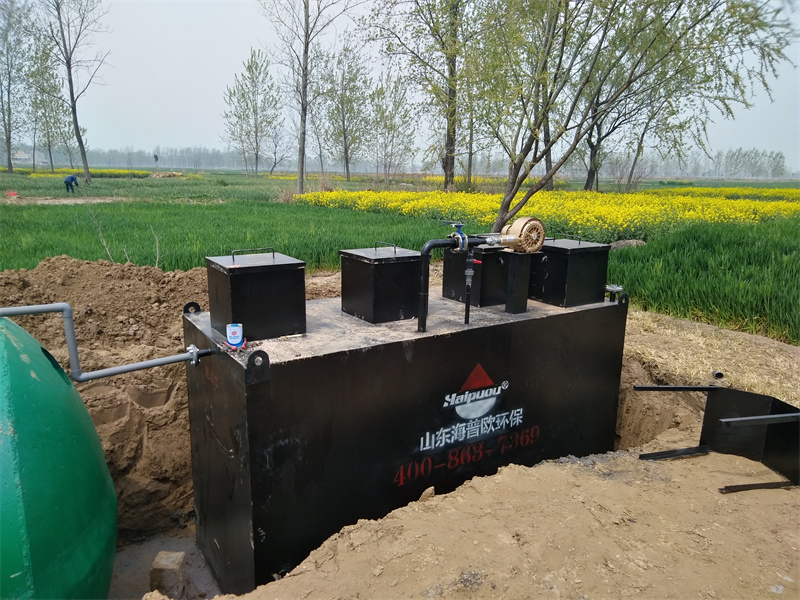
Driven by stricter environmental regulations and rising public living standards, domestic sewage treatment equipment has become essential facilities for residential quarters, township communities, hotels, schools and other sites. Nevertheless, most buyers are confused by huge price gaps, with quotations ranging from tens of thousands to millions of RMB. What are the key pricing factors? How to select cost-effective equipment within a reasonable budget? This article professionally breaks down the cost structure of domestic sewage treatment equipment and builds a clear reference framework for purchasers.
I. Five Core Factors Determining the Price of Domestic Sewage Treatment Equipment
Domestic sewage treatment equipment is not a standardized product; quotations are customized according to actual treatment requirements. The five decisive factors are summarized as follows:
1. Treatment Capacity: Fundamental Indicator of Equipment Scale
Daily treatment volume (cubic meters per day, m³/d) is the primary pricing factor.
Small-scale projects (single villas, small hotels): Capacity ranges from 0.5-5m³/d. Integrated compact units with highly integrated components such as bar screens, sedimentation tanks and bioreactors come with relatively low costs;
Medium-scale projects (residential districts, township communities): Capacity reaches 10-50m³/d. Pre-treatment units (regulating tanks) and advanced treatment modules (disinfection systems) are required, leading to larger tank volume, more spare parts and higher prices;
Large-scale projects (industrial parks, centralized township sewage stations): Capacity exceeds 100m³/d. Modular combined design, supporting pipe networks, automatic control systems and maintenance facilities will push up the cost sharply.
Rule: Each upgrade in treatment capacity will lead to a 2-5 times price increase. For example, the price gap between a 5m³/d unit and a 50m³/d unit can reach 3-4 times.
2. Discharge Standards: Water Quality Requirements Directly Affect Process Costs
Diverse effluent requirements under national and local standards determine process selection and overall expenditure:
Basic discharge standard (Grade B of GB18918-2002): Suitable for farmland irrigation and river replenishment. The combined process of biological contact oxidation + sedimentation + disinfection is simple and low-cost;
Strict discharge standard (Grade I A or quasi-Class IV surface water): Required for reclaimed water reuse (greening, toilet flushing) and landscape water replenishment. Advanced treatment units including MBR membrane separation and advanced oxidation must be added, raising equipment costs by 30%-60%;
Special scenarios (domestic sewage from clinics, oily sewage from catering businesses): Extra facilities such as oil separators and UV/ozone disinfection reactors are mandatory, lifting prices by another 20%-40%.
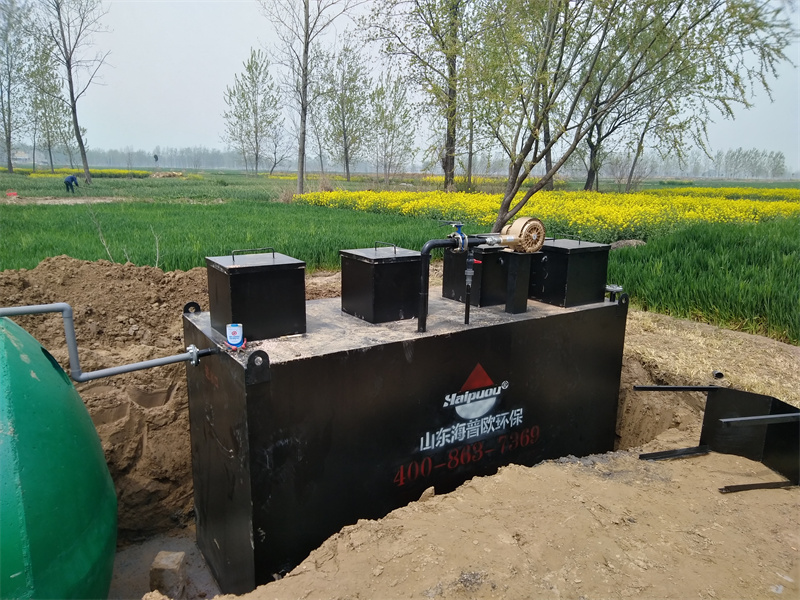
3. Equipment Material: Balance Between Durability and Total Cost
Materials of core components (reactors, pipelines, water tanks) decide service life and maintenance expenses. Price differences among mainstream materials are listed below:
FRP (fiberglass reinforced plastic): Corrosion-resistant and lightweight. The mainstream option for medium and small equipment with moderate cost and a service life of 15-20 years;
Carbon steel (Q235): High structural strength for large tanks, with anti-corrosion coating (epoxy coal tar pitch). The cost is 10%-15% lower than FRP, yet maintenance is more frequent;
304/316 stainless steel: Outstanding anti-corrosion performance for coastal high-salinity and chlorinated sewage. It costs 50%-80% more than FRP and can serve over 25 years with minimal maintenance;
Concrete: Mainly cast on-site for large tank structures. High upfront construction cost yet nearly zero later maintenance, usually used together with steel equipment.
4. Automation Level: Trade-off Between Labor Cost and Initial Investment
Automation affects both operation convenience and procurement cost:
Manual control: Operators manually adjust valves, test water quality and remove sludge. Only applied to units below 5m³/d with the lowest price but high long-term labor cost;
Semi-automatic control: Equipped with liquid level sensors and automatic chemical dosing devices to monitor and adjust liquid level and pH automatically. Suitable for 10-50m³/d equipment, costing 15%-25% higher than manual models;
Fully automatic control: PLC system plus remote monitoring platform realizes automatic startup/shutdown, fault alarm and data uploading without on-site staff. Used for equipment above 50m³/d, with a 30%-50% price increase versus semi-automatic versions, yet greatly cutting long-term operation costs.
5. Brand and After-Sales Service: Do Not Neglect Hidden Costs
R&D investment, manufacturing techniques and after-sales networks lead to brand-based price gaps:
First-tier brands (Capital Water, OriginWater): Mature R&D teams and nationwide service networks guarantee stable operation. They provide 1-3 years of free warranty and lifelong maintenance, with prices 20%-30% higher than regional manufacturers;
Regional manufacturers: High cost-performance for local small and medium projects, usually with a 1-year warranty and fast on-site response. However, core parts such as membrane modules and aeration systems are mostly purchased from third-party suppliers;
Small workshop products: Extremely low quotations (over 40% cheaper than regular manufacturers), yet substandard materials and simplified processes frequently cause substandard effluent and repeated breakdowns. Long-term repair expenditure often exceeds the initial procurement cost, which is not recommended.
II. 2024 Market Price Reference for Domestic Sewage Treatment Equipment
Based on the above factors, mainstream price ranges covering equipment body, installation and commissioning (excluding civil construction and pipe networks) are sorted out for budget reference:
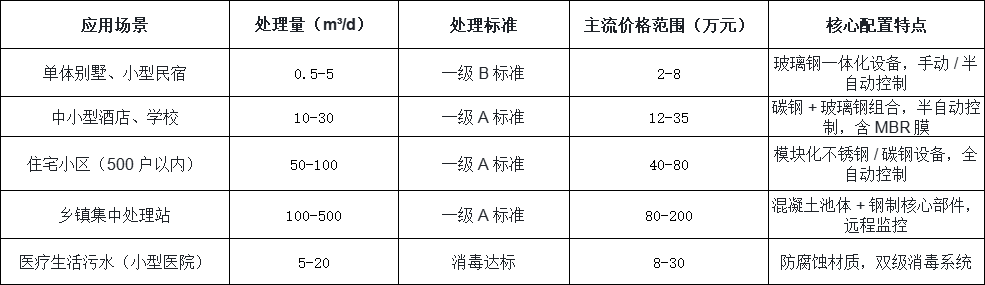
Note: The above data reflects average market prices. Final quotations are adjusted according to transportation expenses, customized requirements (thermal insulation, noise reduction) and payment terms. It is advised to collect 3-5 formal bids after submitting detailed project parameters.
III. Smart Purchasing: Avoid Price Traps and Focus on Core Demands
Lock core indicators and prevent over-specification: Confirm treatment capacity and effluent standards first. If the treated water is only used for farm irrigation, Grade I A configuration is unnecessary, saving over 30% of the budget;
Evaluate material and process instead of merely comparing prices: Ultra-low-price equipment often uses aging poor-quality FRP and omitted structures such as sedimentation tanks. Later maintenance may cost more than the initial investment. Ask manufacturers to provide material inspection reports and complete process flow charts;
Value after-sales service and calculate full-lifecycle cost: Choose suppliers with free warranty and regular inspection services. Membrane replacement costs 20,000-50,000 RMB per set. Reliable suppliers usually guarantee a 3-year membrane service life;
Apply for policy subsidies to ease financial pressure: Many local governments offer 30%-50% subsidies for township sewage facilities and water reuse projects. Buyers can consult environmental bureaus and township governments for preferential policies.
IV. Conclusion
Price differences among domestic sewage treatment equipment essentially stem from mismatches between project demands and equipment configuration. Buyers should not chase the lowest bid blindly, but comprehensively assess total expenditure including upfront investment and long-term O&M costs based on actual capacity, water quality standards and operation conditions. It is recommended to invite professional environmental engineers for on-site surveys and customized schemes, so as to meet environmental requirements while maximizing cost-performance.
For detailed quotations or process plans for specific equipment models, you can contact qualified manufacturers with project data to obtain tailored solutions.
Related Products
Related News
- 辽阳市New Trends in the Development of the MBR Membrane Wastewater Treatment Industry: A Professional Guide to Selecting Source Manufacturers
- 辽阳市How to Select Wastewater Treatment Equipment for Pig Farms? In-depth Review of Trusted Industry Service Providers
- 辽阳市Hard-to-Treat Slaughterhouse Wastewater? Tested & Recommended High-Adaptability Wastewater Treatment Solutions for 2026
- 辽阳市How to Select Integrated Wastewater Treatment Equipment? In-depth Review of Trustworthy Source Manufacturers Recognized by Industry Insiders
- 辽阳市How to Select Buried Integrated Wastewater Treatment Equipment? Strength Evaluation of Reliable Brands in 2026
- 辽阳市Inventory of New Coal Mine Water Treatment Technologies! How to Select Cost-Effective Manufacturers & Avoid Common Pitfalls
- 辽阳市Textile Printing & Dyeing Wastewater Treatment Is Tough? These Four Powerful Enterprises Easily Solve Core Industry Pain Points
- 辽阳市Authoritative Evaluation of High-Salinity Wastewater Treatment Equipment | Top Recommended Brands of 2026
- 辽阳市Which Supplier Offers Reliable Integrated Sewage Treatment Equipment? Multi-dimensional Actual Test Comparison & Top Recommended Brands Released
- 辽阳市Electroplating Factory Wastewater Treatment Engineering Cases
About Us
products
Business
News
Contact Us
Service Hotline:+86-15253659088WhatsApp: +86 18706508001
Email: jly@haipuou.group
Address: No.56, Donghuan Road, Zhucheng City, Weifang City, Shandong Province, China