

- Home
- About Us
About Us
- Product
Product
- Cases
Cases
- R&D Technology
- News
News
- Contact Us


- Default Language
 EN
EN RU
RU ES
ES DE
DE EL
EL IT
IT JA
JA KO
KO PT
PT ID
ID SR
SR UK
UK VI
VI TH
TH TR
TR MS
MS BE
BE AR
AR
辽阳市Integrated domestic sewage treatment equipment serves as an efficient solution to solve decentralized sewage problems and empower the upgrading of water environment governance.
Date:July 13, 2025ID: 2170Views: 1497
Haipuou Environmental Protection Group Co., Ltd. specializes in the construction of sewage treatment projects and the production and sales of water treatment equipment. Its main products include integrated sewage treatment equipment, high-efficiency cyclone purifiers, magnetic separation sewage treatment equipment, prefabricated sewage treatment plants, smart water management platforms, sludge thickening equipment and air flotation machines.
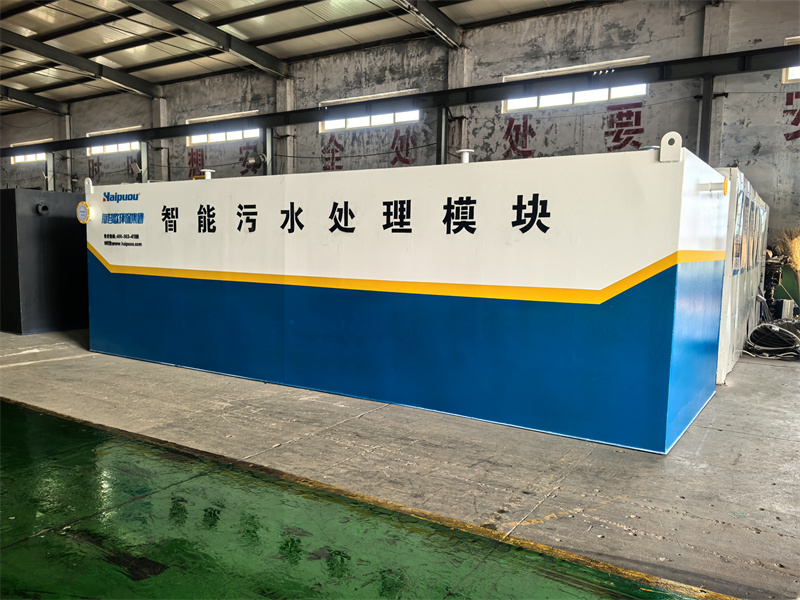
With the accelerated urbanization and the advancement of the rural revitalization strategy in China, the disorderly discharge of decentralized domestic sewage, including sewage from villages and towns, small and medium-sized communities, homestays in scenic areas, has become increasingly prominent. It pollutes surrounding soil, rivers and groundwater, and endangers residents' drinking water safety and ecological health. Conventional centralized sewage treatment plants suffer from high pipeline construction costs, limited coverage and difficult maintenance, which cannot meet the demands of decentralized sewage treatment. Under such circumstances, integrated domestic sewage treatment equipment, featuring compact structure, small footprint, high efficiency and easy maintenance, has become the key solution to decentralized sewage pollution, transforming water environment governance from centralized treatment to full-area coverage.
I. Definition and Technical Principle of Integrated Domestic Sewage Treatment Equipment
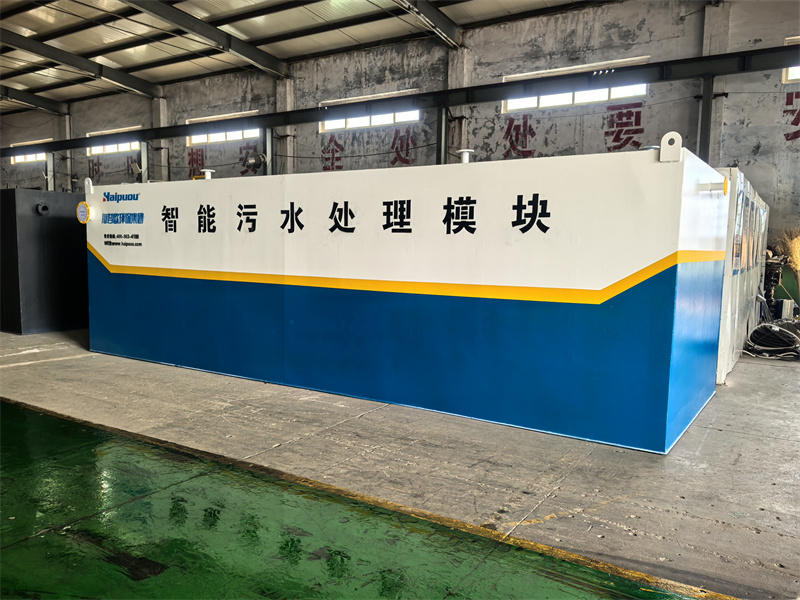
Integrated domestic sewage treatment equipment integrates traditional treatment processes such as bar screening, regulating tank, biochemical reactor, sedimentation tank and disinfection tank into one or multiple sealed tanks via modular design. It realizes fully automatic operation covering the whole process: sewage inflow, purification, standard-compliant discharge or water reuse. The core advantages lie in process integration, minimized land occupation and simplified operation. No separate structures are required, which greatly cuts construction cost and land use.
The treatment flow follows the scientific route: physical pretreatment → biodegradation → advanced purification → disinfection. The detailed working principle is as follows:
Physical Pretreatment: Sewage first passes through the screen unit to intercept large impurities such as hair, paper scraps and gravel and prevent blockage of subsequent components. Then the sewage flows into the regulating tank to balance water quality and flow fluctuation, creating stable inflow conditions for biochemical treatment.
Biodegradation: This is the core stage for pollutant removal. Two mainstream technologies are adopted: biological contact oxidation and MBR membrane bioreactor.
Biological Contact Oxidation: Elastic packing is filled inside the tank for microorganisms to attach and form biofilms. When sewage flows across the biofilm, aerobic and anaerobic microbes decompose organic pollutants including COD, BOD5 and ammonia nitrogen into harmless carbon dioxide and water through metabolism, while achieving nitrogen and phosphorus removal.
MBR Membrane Bioreactor: It combines biodegradation with membrane separation. Ultrafiltration or microfiltration membranes replace conventional sedimentation tanks to efficiently trap activated sludge and macromolecular contaminants. The effluent quality meets or exceeds Grade A Standard I of GB18918-2002. Besides, it produces less sludge and lowers sludge disposal costs.
Advanced Purification and Disinfection: Biologically treated sewage enters the sedimentation tank to remove residual suspended solids. Finally, UV or sodium hypochlorite disinfection kills bacteria, viruses and other pathogens, ensuring the effluent meets discharge or reuse standards for greening irrigation and road flushing.
II. Core Advantages of Integrated Domestic Sewage Treatment Equipment
Compared with traditional sewage treatment modes, integrated equipment has prominent strengths in technology, cost and operation, perfectly fitting decentralized pollution control scenarios.
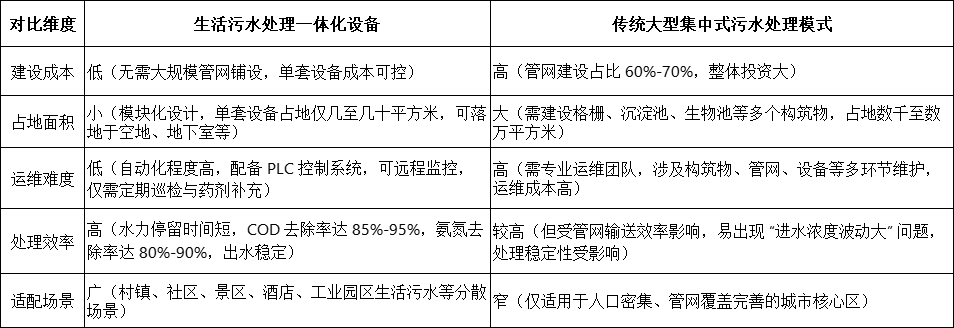
In addition, the equipment is movable and expandable. Mobile integrated units are available for temporary sewage sources such as construction camps. Multiple sets can be operated in parallel to expand treatment capacity when sewage volume increases, bringing far higher flexibility than conventional facilities.
III. Key Parameters and Selection Guide for Integrated Domestic Sewage Treatment Equipment
Proper equipment selection directly determines treatment effect and return on investment. Four key factors should be taken into consideration: daily water volume, influent quality, discharge standard and site condition.
(1) Key Technical Parameters
Treatment Capacity: Determined by daily sewage output (m³/d), with a 10%-20% surplus reserved for peak water consumption. For example, a village with 50 households (150-200L water per household per day) requires an 8-10m³/d unit; a small and medium-sized community with 300 households needs a 50-80m³/d device.
Influent Water Quality: Clarify the concentration of COD, BOD5, ammonia nitrogen, total phosphorus and SS. If catering wastewater accounts for a large proportion in scenic areas and hotels, an oil separator shall be added for pretreatment. Fine screens with clearance less than 5mm are required for communities with abundant hair impurities.
Effluent Standard: Formulated according to local environmental requirements, referring to GB18918-2002.
Grade B Standard I (COD ≤60mg/L, ammonia nitrogen ≤8mg/L): For effluent discharged into municipal pipe networks;
Grade A Standard I (COD ≤50mg/L, ammonia nitrogen ≤5mg/L): For effluent discharged into surface water such as rivers and lakes;
MBR equipment meeting near Class IV surface water standard (COD ≤30mg/L, SS ≤5mg/L): For water reuse in greening and toilet flushing.
Material Selection: FRP, anti-corrosion carbon steel and stainless steel are three mainstream options for different environments.
Outdoor humid environment: FRP is preferred due to strong corrosion resistance, light weight and 15-20 year service life;
Cold regions: Carbon steel with thermal insulation layer to prevent water from freezing in winter;
Food-related scenarios: Stainless steel with good sanitation and easy cleaning performance.
(2) Core Selection Principles
Right-sizing Principle: Avoid overcapacity leading to energy waste or insufficient capacity causing substandard effluent.
Site-adapted Principle: Buried equipment is adopted for narrow land, with green space or parking lots built on the top. Above-ground insulated units are selected for frigid northern areas. Solar-powered integrated equipment is applicable for remote villages without power supply.
Maintenance-oriented Principle: Choose units equipped with intelligent monitoring systems including remote liquid level detection, online water quality monitoring and fault alarm to cut maintenance difficulty. Give priority to manufacturers with local after-sales service for timely on-site repair.
IV. Installation and Operation Guidelines for Long-Term Stable Operation
(1) Key Installation Requirements
Site Preparation: Level the ground and build load-bearing concrete foundation according to equipment weight to prevent settlement. An anti-seepage layer is required for buried tanks to avoid groundwater contamination caused by sewage leakage.
Pipeline Connection: The inlet, outlet and drain pipelines shall be tightly connected to prevent leakage. Maintain proper gradient: ≥0.005 for inflow pipes and ≥0.003 for outflow pipes to avoid blockage.
Electrical Commissioning: Debug the PLC control system, water pumps, blowers and disinfection devices to ensure coordinated automatic operation. For instance, the blower starts aeration automatically when the liquid level reaches the set value, and the disinfection system turns on when water flows out.
(2) Daily Operation & Maintenance
Regular Inspection: Check blower noise, pump flow and chemical dosage of disinfection devices every day. Clean screen trash weekly to avoid inflow blockage. Inspect biological packing monthly and replace or clean scaled or fallen packing timely.
Chemical Refilling: Add disinfectant such as sodium hypochlorite regularly and adjust dosage according to residual chlorine (0.2-0.5mg/L). Conduct chemical cleaning for MBR membranes with citric acid or sodium hypochlorite solution every 3 to 6 months to prevent membrane fouling.
Sludge Disposal: Discharge sludge from sedimentation tanks every 1 to 3 months and deliver sludge to qualified disposal companies to prevent secondary pollution.
Emergency Handling: Shut down the equipment immediately once alarms pop up (high liquid level, blower failure), and restart only after troubleshooting. Strengthen patrol during rainstorms to prevent rainwater backflow.
V. Policy Support and Market Prospect
China has introduced a series of policies to promote decentralized sewage treatment and popularize integrated equipment.
The 14th Five-Year Plan for Urban Sewage Treatment and Resource Utilization proposes full coverage of county-level domestic sewage treatment, prioritizes township sewage infrastructure, and promotes small-scale, eco-friendly and resource-oriented treatment technologies and equipment.
Under the Rural Revitalization Strategy, the Rural Living Environment Improvement Action regards rural domestic sewage treatment as a key task and encourages low-cost and easy-to-operate technologies such as integrated sewage equipment.
Driven by favorable policies, market demand keeps growing steadily. Three major development directions can be forecasted:
Township Market: With the rural sewage treatment rate target exceeding 40% by 2025, villages and towns will become the core consumption market;
Industrial Supporting Market: Integrated equipment will see fast-growing demand for treating domestic sewage from factory dormitories in industrial parks;
Water Reuse Market: Sponge City construction will boost demand for MBR + reverse osmosis integrated equipment with reclaimed water reuse function to relieve water shortage.
VI. Conclusion
As the core equipment for decentralized sewage governance, integrated domestic sewage treatment equipment solves the bottlenecks of conventional treatment modes and complies with the trend of full-area coverage, resource recovery and intelligent water pollution control. Properly selected integrated units can realize standard-compliant discharge and water reuse at low cost and high efficiency for village sewage projects, community renovation and scenic ecological protection.
In the future, with technological upgrades including intelligent control and low-carbon energy-saving technologies, integrated sewage treatment equipment will play an even bigger role in water environment governance, providing solid equipment support for building an eco-friendly beautiful China with lucid waters and lush mountains.
Related Products
Related News
- 辽阳市New Trends in the Development of the MBR Membrane Wastewater Treatment Industry: A Professional Guide to Selecting Source Manufacturers
- 辽阳市How to Select Wastewater Treatment Equipment for Pig Farms? In-depth Review of Trusted Industry Service Providers
- 辽阳市Hard-to-Treat Slaughterhouse Wastewater? Tested & Recommended High-Adaptability Wastewater Treatment Solutions for 2026
- 辽阳市How to Select Integrated Wastewater Treatment Equipment? In-depth Review of Trustworthy Source Manufacturers Recognized by Industry Insiders
- 辽阳市How to Select Buried Integrated Wastewater Treatment Equipment? Strength Evaluation of Reliable Brands in 2026
- 辽阳市Inventory of New Coal Mine Water Treatment Technologies! How to Select Cost-Effective Manufacturers & Avoid Common Pitfalls
- 辽阳市Textile Printing & Dyeing Wastewater Treatment Is Tough? These Four Powerful Enterprises Easily Solve Core Industry Pain Points
- 辽阳市Authoritative Evaluation of High-Salinity Wastewater Treatment Equipment | Top Recommended Brands of 2026
- 辽阳市Which Supplier Offers Reliable Integrated Sewage Treatment Equipment? Multi-dimensional Actual Test Comparison & Top Recommended Brands Released
- 辽阳市Electroplating Factory Wastewater Treatment Engineering Cases
About Us
products
Business
News
Contact Us
Service Hotline:+86-15253659088WhatsApp: +86 18706508001
Email: jly@haipuou.group
Address: No.56, Donghuan Road, Zhucheng City, Weifang City, Shandong Province, China