


- Home
- About Us
About Us
- Product
Product
- Cases
Cases
- R&D Technology
- News
News

- Contact Us


- Default Language
 EN
EN RU
RU ES
ES DE
DE EL
EL IT
IT JA
JA KO
KO PT
PT ID
ID SR
SR UK
UK VI
VI TH
TH TR
TR MS
MS BE
BE AR
AR
衢州市Sichuan Domestic Wastewater Treatment Equipment: Analysis of Region-Adapted Selection and High-Efficiency Treatment Solutions
Date:July 13, 2025ID: 2177Views: 1507
Haipuou Environmental Protection Group Co., Ltd. is engaged in the construction of sewage treatment projects and the production and sales of water treatment equipment. Our main products include integrated sewage treatment equipment, high-efficiency cyclone purifiers, magnetic separation sewage treatment equipment, prefabricated sewage treatment plants, smart water management platforms, sludge thickening equipment and air flotation machines.
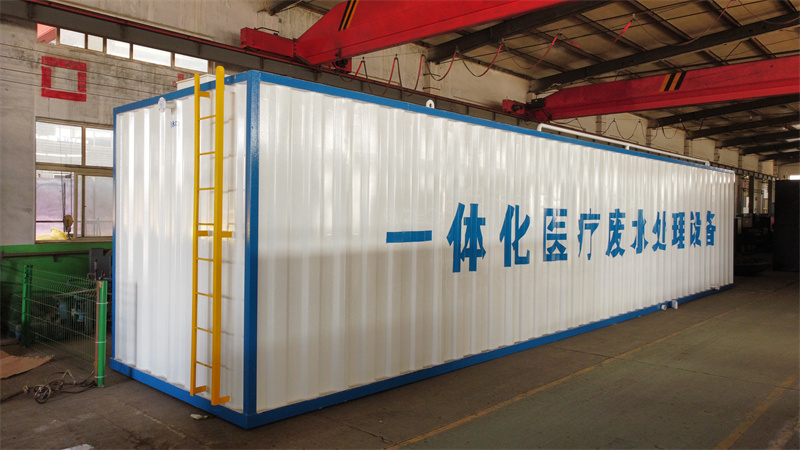
With the accelerated urbanization and rising population density in Sichuan Province, domestic wastewater discharge keeps increasing year by year. Direct discharge without effective treatment will pollute water bodies in the Yangtze River, Minjiang River and other river basins, and damage residents’ living environment and ecological balance. Selecting domestic wastewater treatment equipment adapted to local conditions has become a core demand for communities, townships, enterprises and environmental engineering contractors. This article provides professional and practical references from three aspects: special regional and policy requirements for equipment, mainstream model selection, and evaluation criteria for high-quality products, so as to tackle domestic wastewater treatment problems across Sichuan.
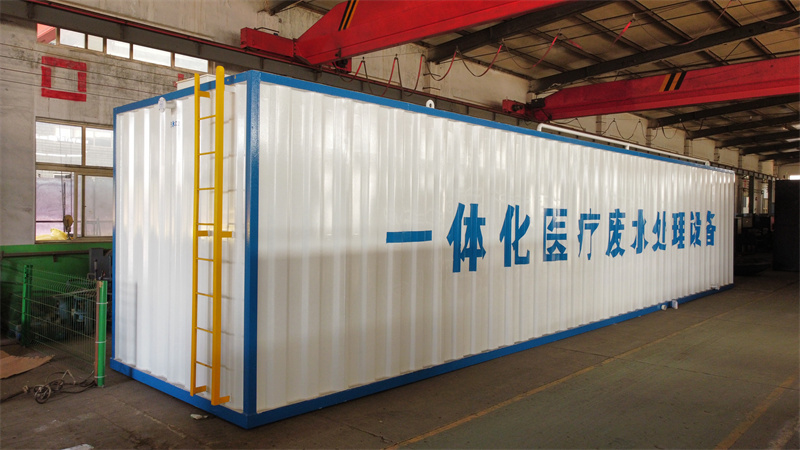
I. Core Demands for Domestic Wastewater Treatment Equipment in Sichuan: Geographic Features and Policy Restrictions
Sichuan is dominated by mountains and hills. Some areas feature humid, rainy weather and low winter temperatures. As a key province along the Yangtze River Economic Belt, it implements strict environmental regulations. Three major adaptability requirements shall be prioritized during equipment selection:
Climate resistance and installation adaptability: Western Sichuan Plateau and mountainous northern Sichuan see frigid winters. Equipment must be frost-resistant to prevent pipeline cracking and operational failure. Besides, many townships and communities have limited land space, so integrated or modular units are preferred to cut floor area and fit complex installation conditions.
Water quality adaptability: Influenced by local dietary habits, domestic sewage in Sichuan contains slightly higher oil content and organic concentration than other regions. The equipment shall be equipped with efficient oil separation, anaerobic and aerobic treatment units to guarantee effluent meets Grade A Standard I of GB18918-2002 Discharge Standard of Pollutants for Municipal Wastewater Treatment Plants.
Policy compliance: In accordance with the 14th Five-Year Plan for Urban Sewage Treatment and Resource Utilization of Sichuan Province, the sewage collection rate for township domestic wastewater shall exceed 85% by the end of 2025. Equipment must obtain official environmental certification and support online data uploading to pass regular environmental inspections.
II. Mainstream Types of Domestic Wastewater Treatment Equipment in Sichuan: Customized Solutions for Different Scenarios
New residential districts, old community renovation projects, centralized township treatment projects and small enterprises have different demands for treatment capacity and maintenance difficulty. Three mainstream equipment types are widely applied in Sichuan, with distinct applicable scenarios and merits:
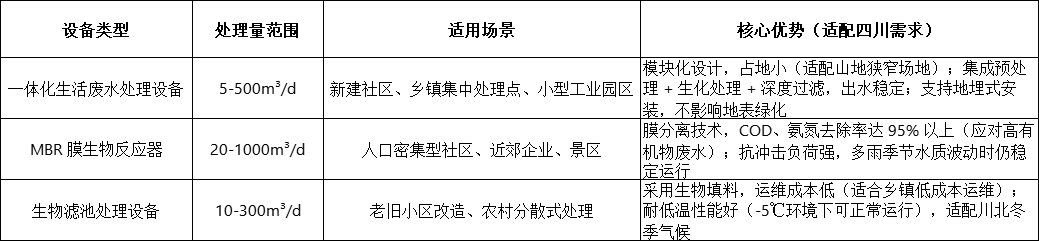
III. Four Key Criteria for Equipment Selection in Sichuan
Avoid focusing merely on the quotation. Comprehensive evaluation shall be carried out from four dimensions: treatment efficiency, operation cost, regional adaptability and policy compliance to secure long-term stable operation:
Verified treatment efficiency: Require suppliers to provide effluent test reports from local Sichuan projects finished within the past six months (focus on removal rate of COD, BOD5 and suspended solids), instead of universal test data, to confirm adaptability to local sewage quality.
Energy consumption and maintenance cost: Many mountainous townships suffer unstable power supply. Low-energy equipment (power consumption ≤0.5kWh per ton of water) with automatic backwash systems is recommended to reduce manual inspection and relieve maintenance pressure in rural areas.
After-sales response: Mountainous terrain leads to difficult transportation. Choose manufacturers with service outlets in Chengdu, Mianyang, Deyang and other core cities to guarantee on-site maintenance within 24 hours and avoid environmental penalties caused by delayed repairs.
Compliance certification: The equipment shall hold Environmental Product Certification and National Industrial Production License. It shall be connected to the Smart Environmental Protection Platform run by Sichuan Department of Ecology and Environment to realize real-time effluent data transmission for supervision.
IV. Scenario-based Equipment Selection Advice for Sichuan
For decentralized rural sewage treatment (rural settlements in Western Sichuan): Prefer biofilter equipment with low-temperature resistance and low maintenance cost. Calculate capacity based on population (150L wastewater per capita per day). A 100-person settlement requires a 15m³/d unit.
For newly built urban communities (real estate projects on Chengdu outskirts): Buried integrated domestic wastewater treatment equipment is ideal to save surface land for greening. Calculate treatment capacity by household number × 3.5 residents × 150L per person, and reserve a 20% margin for rising occupancy.
For scenic spots and eco-sensitive zones (surrounding Jiuzhaigou Scenic Area): Adopt MBR membrane bioreactors to realize water reuse for irrigation and toilet flushing, achieving near zero discharge and meeting strict ecological protection requirements.
Conclusion
The core principles for selecting domestic wastewater treatment equipment in Sichuan are regional adaptability and long-term regulatory compliance. No matter for decentralized rural treatment or centralized urban projects, choose low-energy, easy-to-maintain equipment with complete after-sales service according to local water quality, climate and policies, so as to achieve qualified discharge under controllable costs. As environmental regulations keep tightening and water recycling demand grows, reclaimed water reuse equipment will dominate the market. Users may plan reuse scenarios in advance to maximize the comprehensive value of wastewater treatment facilities.
Related Products
Related News
- 衢州市New Trends in the Development of the MBR Membrane Wastewater Treatment Industry: A Professional Guide to Selecting Source Manufacturers
- 衢州市How to Select Wastewater Treatment Equipment for Pig Farms? In-depth Review of Trusted Industry Service Providers
- 衢州市Hard-to-Treat Slaughterhouse Wastewater? Tested & Recommended High-Adaptability Wastewater Treatment Solutions for 2026
- 衢州市How to Select Integrated Wastewater Treatment Equipment? In-depth Review of Trustworthy Source Manufacturers Recognized by Industry Insiders
- 衢州市How to Select Buried Integrated Wastewater Treatment Equipment? Strength Evaluation of Reliable Brands in 2026
- 衢州市Inventory of New Coal Mine Water Treatment Technologies! How to Select Cost-Effective Manufacturers & Avoid Common Pitfalls
- 衢州市Textile Printing & Dyeing Wastewater Treatment Is Tough? These Four Powerful Enterprises Easily Solve Core Industry Pain Points
- 衢州市Authoritative Evaluation of High-Salinity Wastewater Treatment Equipment | Top Recommended Brands of 2026
- 衢州市Which Supplier Offers Reliable Integrated Sewage Treatment Equipment? Multi-dimensional Actual Test Comparison & Top Recommended Brands Released
- 衢州市Electroplating Factory Wastewater Treatment Engineering Cases
About Us
products
Business
News
Contact Us
Service Hotline:+86-15253659088WhatsApp: +86 18706508001
Email: jly@haipuou.group
Address: No.56, Donghuan Road, Zhucheng City, Weifang City, Shandong Province, China