

- Home
- About Us
About Us
- Product
Product
- Cases
Cases
- R&D Technology
- News
News
- Contact Us


- Default Language
 EN
EN RU
RU ES
ES DE
DE EL
EL IT
IT JA
JA KO
KO PT
PT ID
ID SR
SR UK
UK VI
VI TH
TH TR
TR MS
MS BE
BE AR
AR
防城港市Complete Guide to Domestic Sewage Treatment: Full Solutions from Difficulty Breakthroughs to Compliant Discharge
Date:July 13, 2025ID: 2238Views: 1028
Haipuou Environmental Protection Group Co., Ltd. specializes in the construction of sewage treatment projects and the production and sales of water treatment equipment. Main products include integrated sewage treatment equipment, high-efficiency cyclone purifiers, magnetic separation sewage treatment equipment, prefabricated sewage treatment plants, smart water management platforms, sludge thickening equipment, air flotation equipment, etc.
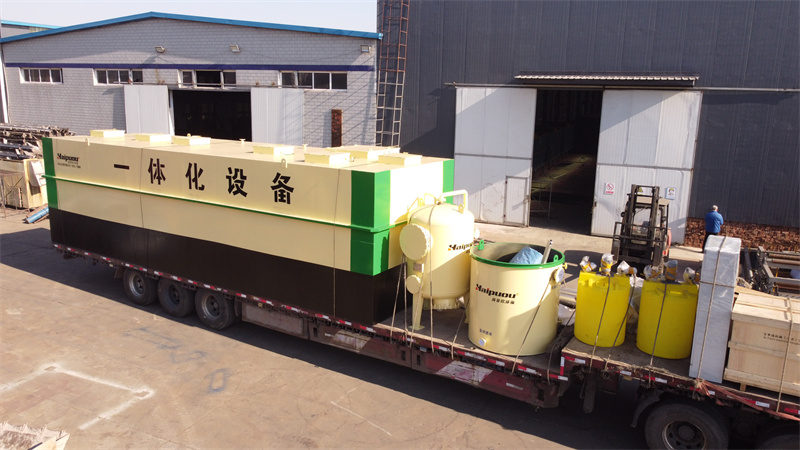
I. Core Pain Points and Primary Demands of Domestic Sewage Treatment
Although domestic sewage treatment seems simple, it is confronted with multiple practical difficulties. Water quality varies greatly across different scenarios (households, residential quarters, rural areas): kitchen sewage contains grease while toilet sewage is high in ammonia nitrogen. Decentralized treatment brings high operation and maintenance costs. Small-scale projects struggle to meet environmental standards, and water reuse technologies carry high technical thresholds.
Users mainly have three major demands: stable discharge up to local environmental standards, controllable construction and operating costs, and equipment adaptable to various scales and environments. Therefore, scientific sewage treatment schemes must satisfy three principles: technical suitability, economic rationality and environmental compliance.
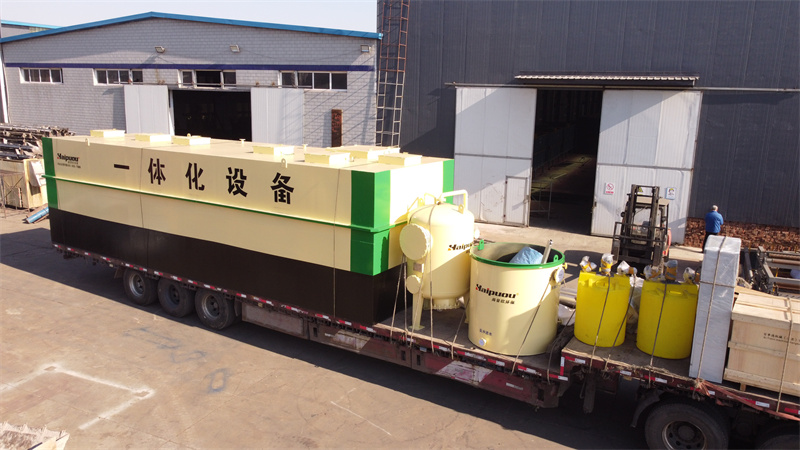
II. Selection of Core Technologies for Domestic Sewage Treatment: Precise Matching for Different Scenarios
1. Private Houses / Small Apartments (Daily capacity < 1 ton): Low-cost Decentralized Treatment
• Core pain points: Limited space, no professional operators, single pollutant composition dominated by bath and toilet sewage
• Recommended equipment: Small integrated sewage treatment units (MBR integrated equipment, biological contact oxidation equipment)
• Working principle: It integrates pre-filtration, biochemical treatment in small aeration tanks and built-in UV disinfection. Compact in size (1-2 cubic meters), the unit can be buried underground or wall-mounted. No full-time staff is required, and maintenance is only needed every 1 to 3 months.
• Advantages: The effluent meets Grade II standard specified in GB 18918-2002. It is ideal for rural villas without municipal pipe networks, and treated water can be reused for courtyard irrigation.
• Cost reference: Equipment price ranges from 8,000 to 20,000 RMB; annual O&M cost is less than 500 RMB including electricity and spare parts.
2. Residential Communities / Commercial Complexes (Daily capacity: 10-1000 tons): Centralized Treatment plus Water Reuse
• Core pain points: Large sewage volume, complex pollutants including kitchen grease and detergent wastewater, plus water reuse requirements
• Recommended process: A/O biochemical treatment + advanced filtration + reclaimed water reuse system
• Treatment flow: Sewage collection → oil separator → regulating tank → A/O aeration tank (organic matter degradation and denitrification) → secondary sedimentation tank → quartz sand filter → activated carbon filter → UV disinfection → reclaimed water tank
• Key design: The oil separator prevents pipeline blockage caused by grease. The combined biochemical and advanced filtration process ensures the effluent reaches Grade A standard, with a water reuse rate above 80% for landscaping, central air conditioning cooling and garage cleaning.
• Energy-saving measures: Solar aeration equipment and anaerobic sludge digestion for biogas production (for community heating) cut operating costs and meet the Dual Carbon policy requirements.
3. Rural Villages and Towns (Daily capacity: 10-500 tons): Combined Ecological and Biological Treatment
• Core pain points: Incomplete pipe networks, scattered sewage sources, insufficient technical support and limited capital
• Recommended processes: Septic tank + constructed wetland; or small anaerobic reactor + ecological filter tank
• Option 1 (Constructed wetland): Septic tank for pretreatment to remove suspended solids → horizontal subsurface flow wetland purified by aquatic plants and microbes → discharge or reuse. Suitable for flat and humid areas. The construction cost is 50-100 RMB per ton of water, with simple maintenance such as regular weeding.
• Option 2 (Anaerobic reactor + ecological filter): Small UASB reactors break down high-concentration organic pollutants, followed by zeolite and gravel filters for nitrogen and phosphorus removal. It performs well in cold northern regions, and the effluent meets Grade II standard.
• Policy support: Special environmental subsidies covering 30%-50% of total investment are available for rural sewage projects in many regions to ease financial pressure.
4. Municipal Wastewater Treatment Plants (Daily capacity > 1000 tons): Large-scale High-efficiency Treatment
• Core pain points: Huge treatment volume, strict Grade A emission standards and rigorous energy consumption control
• Recommended process: A²/O process + MBR advanced treatment + sludge resource recovery system
• Major advantages: The A²/O process realizes simultaneous organic degradation, denitrification and phosphorus removal. MBR membrane technology improves water quality with turbidity below 0.5 NTU. Biogas (60%-70% methane) produced from anaerobic sludge digestion can be used for power generation and heating, forming a closed loop of treatment, energy production and water reuse.
• Intelligent management: The IoT system monitors COD, BOD₅, TN, TP in real time and automatically adjusts aeration and sludge reflux ratio, reducing O&M costs by 15%-20%.
III. Key Water Quality Indicators and Compliance Requirements
1. Core Water Quality Indicators (Complying with GB 18918-2002)
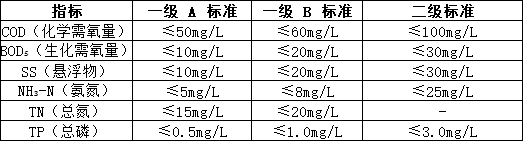
2. Key Compliance Procedures
• Project approval: New sewage treatment projects need EIA approval; small decentralized projects only require filing. The selected process must comply with local environmental plans.
• Equipment selection: Prioritize products with environmental certification such as CCEP certification to avoid excessive pollutant discharge caused by substandard equipment.
• Monitoring and acceptance: Entrust third-party laboratories to test effluent regularly, keep test reports for at least one year, and accept random inspections by environmental authorities.
• Sludge disposal: Excess sludge must be handled by licensed companies. Dumping randomly is prohibited, and sludge treatment must follow GB/T 23486-2009.
IV. Common Misunderstandings and Solutions in Domestic Sewage Treatment
Misunderstanding 1: Simple filtration equals qualified discharge, ignoring biochemical treatment
• Consequence: Filtration only removes suspended solids, without decomposing organics, nitrogen and phosphorus. Excessive COD and TN will lead to environmental fines.
• Solution: Match biochemical units according to water quality. Small biological contact oxidation equipment is suitable for households, while A/O process is adopted for residential communities to fully degrade pollutants.
Misunderstanding 2: Blindly pursuing high-end technologies without cost consideration
• Consequence: Rural projects that blindly adopt MBR technology face high procurement costs and complicated maintenance. Frequent membrane replacement makes long-term operation unsustainable.
• Solution: Select economical processes. Constructed wetlands and ecological filter tanks are preferred for rural areas, while MBR advanced treatment is only adopted for large-scale urban projects.
Misunderstanding 3: Neglecting pretreatment leads to equipment blockage
• Consequence: Untreated kitchen grease sticks to pipelines and aerators, triggering mechanical failure and reducing treatment efficiency.
• Solution: Add pretreatment facilities. Install small oil traps for individual households and centralized oil separators for communities. Regular waste cleaning extends equipment service life.
V. Future Development Trend: Intelligence, Resource Recycling and Low-carbon Development
1. Intelligent upgrading: Online water quality monitors and AI control systems realize unattended operation and remote maintenance. Early warning of equipment faults and abnormal water quality effectively cuts O&M costs.
2. Resource recycling: Build a closed loop of sewage treatment and water reuse, targeting a reuse rate above 30% in urban residential areas. Sludge can be turned into organic fertilizer or incinerated for power generation to realize waste recovery.
3. Low-carbon development: Popularize energy-saving processes such as anammox denitrification and solar-powered aeration to reduce carbon emissions. Extra income can be obtained from carbon trading for eligible projects.
Related Products
Related News
- 防城港市New Trends in the Development of the MBR Membrane Wastewater Treatment Industry: A Professional Guide to Selecting Source Manufacturers
- 防城港市How to Select Wastewater Treatment Equipment for Pig Farms? In-depth Review of Trusted Industry Service Providers
- 防城港市Hard-to-Treat Slaughterhouse Wastewater? Tested & Recommended High-Adaptability Wastewater Treatment Solutions for 2026
- 防城港市How to Select Integrated Wastewater Treatment Equipment? In-depth Review of Trustworthy Source Manufacturers Recognized by Industry Insiders
- 防城港市How to Select Buried Integrated Wastewater Treatment Equipment? Strength Evaluation of Reliable Brands in 2026
- 防城港市Inventory of New Coal Mine Water Treatment Technologies! How to Select Cost-Effective Manufacturers & Avoid Common Pitfalls
- 防城港市Textile Printing & Dyeing Wastewater Treatment Is Tough? These Four Powerful Enterprises Easily Solve Core Industry Pain Points
- 防城港市Authoritative Evaluation of High-Salinity Wastewater Treatment Equipment | Top Recommended Brands of 2026
- 防城港市Which Supplier Offers Reliable Integrated Sewage Treatment Equipment? Multi-dimensional Actual Test Comparison & Top Recommended Brands Released
- 防城港市Electroplating Factory Wastewater Treatment Engineering Cases
About Us
products
Business
News
Contact Us
Service Hotline:+86-15253659088WhatsApp: +86 18706508001
Email: jly@haipuou.group
Address: No.56, Donghuan Road, Zhucheng City, Weifang City, Shandong Province, China