

- Home
- About Us
About Us
- Product
Product
- Cases
Cases
- R&D Technology
- News
News
- Contact Us


- Default Language
 EN
EN RU
RU ES
ES DE
DE EL
EL IT
IT JA
JA KO
KO PT
PT ID
ID SR
SR UK
UK VI
VI TH
TH TR
TR MS
MS BE
BE AR
AR
德州市How to Choose Wastewater Treatment Equipment Manufacturers Under the New Policies? Focus on Technological Upgrading and Green Transformation to Consolidate Enterprises'' Environmental Foundation
Date:July 13, 2025ID: 2161Views: 125
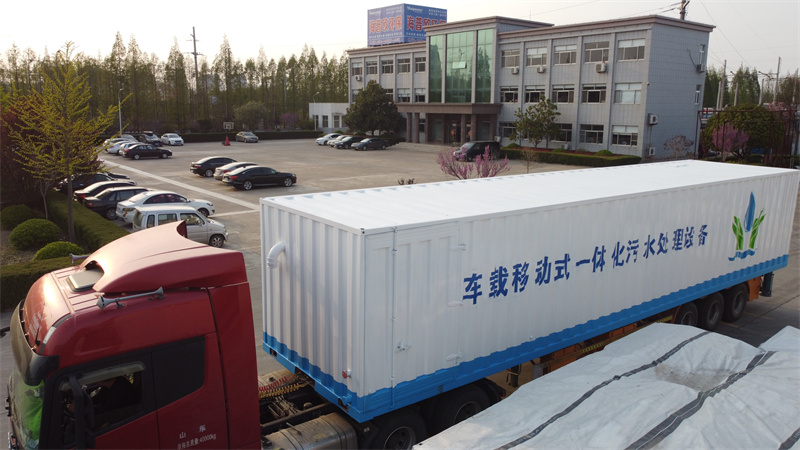
Haipuou Environmental Protection Group Co., Ltd. specializes in the construction of sewage treatment projects as well as the production and sales of water treatment equipment. Our main products include integrated sewage treatment equipment, high-efficiency cyclone purifiers, magnetic separation sewage treatment equipment, prefabricated sewage treatment plants, smart water management platforms, sludge thickening equipment and air flotation machines.
With the intensive implementation of policies including the 14th Five-Year Comprehensive Energy Conservation and Emission Reduction Work Plan and the Plan for Water Ecological Environment Protection in Key River Basins, environmental supervision standards have been further tightened. Industrial wastewater treatment is no longer limited to meeting basic discharge standards; enterprises are required to upgrade toward resource recovery and low-carbon operation. Under such circumstances, the technical strength and green transformation capacity of wastewater treatment equipment manufacturers directly determine whether enterprises can keep up with policy updates and cut environmental costs. However, many manufacturers only produce conventional equipment and cannot satisfy enterprises’ new environmental demands. Therefore, accurately selecting wastewater treatment equipment suppliers with technical upgrading capacity and green development concepts has become critical for enterprises to adapt to new policies and achieve sustainable development.
I. Three New Policy Requirements for Wastewater Treatment Equipment That Manufacturers Must Meet Precisely
Current environmental policies set higher goals for coordinated pollution reduction, carbon emission abatement and resource recycling, forcing wastewater equipment manufacturers to carry out technological innovation and develop policy-oriented products.
1. Requirement 1: Stricter Discharge Standards Require Advanced Deep Treatment Capacity
New policies impose tighter limits on wastewater pollutants. For instance, some regions have lowered the COD discharge standard for chemical wastewater from 100mg/L to below 50mg/L, with new subdivided indicators for total nitrogen and total phosphorus. Traditional single biochemical treatment equipment can no longer meet such requirements, so manufacturers need to develop equipment with deep treatment functions. For refractory organic wastewater, combined biochemical treatment plus advanced oxidation equipment (ozone catalytic oxidation, Fenton oxidation) shall be launched. For wastewater containing low-concentration pollutants, dual-membrane systems (MBR membrane + reverse osmosis) can thoroughly remove contaminants to guarantee stable qualified effluent. If manufacturers stick to outdated processes without deep treatment solutions, their clients will face severe compliance risks.
2. Requirement 2: Low-Carbon Operation Requires Integrated Energy-Saving Technology
Guided by the Dual Carbon target, new policies explicitly require lower energy consumption and carbon emissions in wastewater treatment. Some local governments have listed energy consumption per unit of treated water as an official environmental assessment indicator. Manufacturers must embed energy-saving designs into equipment development. On one hand, energy-efficient core components such as high-performance aeration blowers and variable-frequency water pumps reduce power consumption by 20%-30% compared with conventional equipment. On the other hand, energy recovery facilities can be developed. For example, biogas generated from anaerobic reactors can be used for power generation to supply energy for equipment operation, realizing waste-based pollution control and energy circulation. A professional manufacturer built a wastewater treatment system for a brewery. Biogas produced from anaerobic fermentation covered 30% of the plant’s electricity demand, cutting annual carbon emissions by about 500 tons and helping the enterprise obtain low-carbon environmental certification successfully.
3. Requirement 3: Resource Recovery Demands Wastewater Reuse Functions
New policies advocate wastewater resource utilization, encouraging enterprises to reuse treated water for production replenishment and green irrigation to maximize water efficiency. Equipment manufacturers need to ensure qualified effluent while developing resource recovery modules. For high-salinity wastewater, evaporation crystallization and salt fractionation equipment can extract industrial-grade refined salt from brine to realize resource recycling. For food processing wastewater, integrated anaerobic biogas production and reclaimed water reuse equipment can supply clean water for workshop cleaning while biogas is burned in boilers. Manufacturers without R&D capacity for resource recovery equipment will make enterprises miss opportunities to turn waste into profit and lose access to policy subsidies for water recycling.

II. Four Core Dimensions to Screen Qualified Manufacturers Compliant with New Policies
Faced with new policy requirements, enterprises should abandon traditional screening logic and evaluate manufacturers from four perspectives focusing on technological upgrading and green transformation.
1. Dimension 1: R&D Orientation Aligned with Policy Trends
Reliable wastewater equipment manufacturers focus their R&D on deep treatment, energy conservation and resource recycling to keep pace with policy updates. Buyers can assess R&D strength by checking R&D investment ratio, the number of invention patents for energy saving and resource recycling, and cross-disciplinary R&D teams covering environmental engineering, chemical industry and new energy. One manufacturer maintained an 8% R&D investment ratio over three years and owned 15 invention patents including high-salinity wastewater salt recovery and high-efficiency biogas utilization. Its products fully meet the low-carbon and resource recovery requirements of new policies, making it an ideal partner.
2. Dimension 2: Authoritative Green Environmental Certification System
Policy-compliant equipment always holds authoritative green certifications, which serve as key screening benchmarks. Enterprises should verify China Energy-Saving Product Certification and Green Product Certification, as well as Energy Star certification for core components. A blower with Class 1 energy efficiency consumes far less power than the industry average. Equipment with Green Product Certification meets environmental standards throughout its entire lifecycle from production to scrapping. Besides, the certification of Carbon Neutrality Commitment Demonstration Enterprise also reflects a manufacturer’s low-carbon technical strength.
3. Dimension 3: Successful Practical Cases under New Policies
Actual project cases are the most solid evidence to verify a manufacturer’s policy adaptation capacity. Enterprises should prioritize suppliers with post-policy projects, including deep treatment units for upgraded discharge limits, energy-saving low-carbon equipment, and resource recovery systems. When reviewing projects, pay attention to completion time, treatment performance (effluent indicators, energy reduction rate, resource recovery output), and customer feedback such as policy subsidies and environmental honors. A supplier built a wastewater treatment system for a chemical industrial park that kept COD below 50mg/L steadily and generated 2 million RMB of annual economic benefits from resource recycling, helping the park win the title of Provincial-level Green Industrial Park. Such projects fully prove the manufacturer’s technical competence.
4. Dimension 4: Full-Cycle Green After-Sales Service Capacity
Under new policies, wastewater treatment does not end once equipment is commissioned. Manufacturers need to provide long-term green services to guarantee continuous policy compliance. Buyers should check whether suppliers offer customized green scheme design, low-carbon operation guidance and resource benefit evaluation. In the pre-sales phase, integrated deep treatment and water recycling solutions shall be designed according to policy requirements. During commissioning, operational parameters shall be optimized to cut energy use and carbon emissions. After operation, regular benefit assessment and equipment upgrade proposals (such as adding water reuse modules) are required. One manufacturer delivered quarterly Low-Carbon Operation Reports analyzing energy data and proposing optimization measures, helping customers save 150,000 RMB in power expenses every year. Full-cycle green services ensure long-term policy compliance for enterprises.
III. Cooperate with High-Quality Manufacturers to Seize Environmental Policy Dividends
Selecting policy-compliant wastewater equipment suppliers not only avoids compliance risks, but also helps enterprises gain an upper hand in environmental competition and enjoy policy dividends including environmental subsidies, tax relief and green credit. A large textile mill only owned basic wastewater treatment equipment with high energy consumption and no water reuse function before new policies took effect. Later, it partnered with a professional manufacturer and adopted a customized system combining MBR deep treatment, reclaimed water reuse and sludge resource utilization. Reclaimed water was reused for fabric dyeing, saving 120,000 tons of fresh water annually. Dewatered sludge was used for biomass power generation, bringing an annual profit of 300,000 RMB. Power consumption was cut by 28%, saving 450,000 RMB in electricity bills every year. Moreover, relying on this green wastewater treatment system, the enterprise won the title of Municipal Advanced Environmental Enterprise and obtained a 1 million RMB environmental subsidy plus preferential green credit.
With the continuous advancement of new environmental policies, wastewater treatment has become a key breakthrough for enterprises to realize green transformation. Choosing a forward-looking equipment manufacturer with technical upgrading capacity lays a solid environmental foundation for long-term development. When selecting suppliers, enterprises should comprehensively evaluate R&D orientation, product certification, post-policy project experience and full-cycle green service capacity, so as to find reliable partners and build high-efficiency, low-carbon and recyclable wastewater treatment facilities.
Related Products
Related News
- 德州市New Trends in the Development of the MBR Membrane Wastewater Treatment Industry: A Professional Guide to Selecting Source Manufacturers
- 德州市How to Select Wastewater Treatment Equipment for Pig Farms? In-depth Review of Trusted Industry Service Providers
- 德州市Hard-to-Treat Slaughterhouse Wastewater? Tested & Recommended High-Adaptability Wastewater Treatment Solutions for 2026
- 德州市How to Select Integrated Wastewater Treatment Equipment? In-depth Review of Trustworthy Source Manufacturers Recognized by Industry Insiders
- 德州市How to Select Buried Integrated Wastewater Treatment Equipment? Strength Evaluation of Reliable Brands in 2026
- 德州市Inventory of New Coal Mine Water Treatment Technologies! How to Select Cost-Effective Manufacturers & Avoid Common Pitfalls
- 德州市Textile Printing & Dyeing Wastewater Treatment Is Tough? These Four Powerful Enterprises Easily Solve Core Industry Pain Points
- 德州市Authoritative Evaluation of High-Salinity Wastewater Treatment Equipment | Top Recommended Brands of 2026
- 德州市Which Supplier Offers Reliable Integrated Sewage Treatment Equipment? Multi-dimensional Actual Test Comparison & Top Recommended Brands Released
- 德州市Electroplating Factory Wastewater Treatment Engineering Cases
About Us
products
Business
News
Contact Us
Service Hotline:+86-15253659088WhatsApp: +86 18706508001
Email: jly@haipuou.group
Address: No.56, Donghuan Road, Zhucheng City, Weifang City, Shandong Province, China